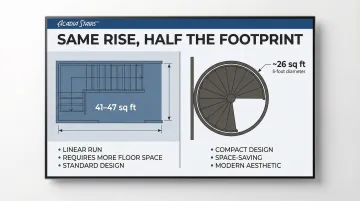
Many loft owners face a common tension: how do you connect a mezzanine or sleeping loft to the main living area without sacrificing precious square footage or compromising your design vision? A straight staircase connecting a 10-foot floor-to-floor height demands roughly 15 feet of horizontal run, consuming 41-47 square feet of floor space. A spiral staircase with a 5-foot diameter occupies just 26 square feet—nearly half the footprint—while adding sculptural interest that straight stairs simply can't match.
This guide explores spiral staircase ideas specifically for loft apartments, covering design styles from industrial raw steel to Scandinavian wood-and-metal combinations, material options including powder-coated steel and tempered glass, space planning strategies for floor openings and ceiling clearance, railing configurations from cable systems to glass panels, and realistic budget expectations for custom fabrication and installation.
TLDR:
- Spiral staircases use 40-50% less floor space than straight stairs for the same rise
- Industrial steel and modern minimalist styles dominate loft applications
- Steel frames with wood or glass treads offer the best balance of durability and aesthetics
- Code-compliant residential spirals require minimum 26-inch clear width and 6.75-inch tread depth
- Budget $5,000-$10,000 for custom steel-and-wood spirals, plus $2,000-$10,000 for installation
Why Spiral Staircases Work So Well in Loft Apartments
The compact footprint of a spiral staircase—typically 4–6 feet in diameter—makes it uniquely suited to loft apartments where every square foot counts. While a code-compliant straight staircase connecting a 9–10 foot vertical rise requires approximately 41–47 square feet of floor space, a 5-foot diameter spiral occupies roughly 26 square feet. This efficiency becomes critical in loft environments where sacrificing large floor areas would compromise the open-plan living that makes these spaces desirable.
The vertical, sculptural form of a spiral staircase complements loft architecture in ways straight stairs cannot. Exposed ceilings, industrial finishes, double-height volumes, and raw concrete walls all benefit from a staircase that draws the eye upward rather than cutting horizontally across the room. The helix creates visual interest from every angle, functioning as a three-dimensional sculpture that anchors the space.
Dual functionality defines the loft spiral staircase:
- Connects living level to mezzanine or sleeping loft without eating into usable floor area
- Draws the eye upward, reinforcing the loft's vertical scale
- Acts as a room's focal point — furniture arranges around it, not despite it
- Complements exposed structural elements rather than clashing with them
In open-plan lofts where the staircase remains visible from most vantage points, this dual role matters. A well-chosen spiral can tie together an otherwise raw, unfinished aesthetic — giving the space a deliberate, designed quality that a tucked-away straight stair never could.
Top Spiral Staircase Design Styles for Loft Spaces
Industrial Spiral: Raw Steel and Exposed Structure
The industrial spiral staircase celebrates structural honesty. Raw steel or blackened metal frames with open-grate or plate treads complement the exposed brick walls, concrete floors, and steel beam ceilings common in converted warehouse lofts.
Key characteristics:
- Matte black or raw steel powder-coat finishes
- Exposed welds and minimal ornamentation
- Open-grate or diamond plate treads
- Heavy-gauge steel construction
- Visible center column and structural connections
This style works particularly well in lofts with existing industrial elements — the staircase leans into its mechanical nature rather than concealing it.
Acadia Stairs offers powder coating options including flat black finishes that deliver an authentic industrial look with corrosion resistance built in.
Modern Minimalist Spiral: Clean Lines and Monochromatic Palettes
The minimalist spiral strips away ornamentation in favor of pure form. Slender steel spindles, solid-surface treads in wood or stone, and tight helical geometry create an understated elegance suited to contemporary high-rise lofts.
Design elements include:
- Monochromatic color schemes (white, black, or gray)
- Thin-profile steel components
- Smooth wood or stone treads without texture
- Simple handrail designs
- Precise geometric alignment
In light-filled lofts with neutral palettes and modern furnishings, the minimalist spiral becomes part of the background architecture rather than competing for attention. The result: a staircase that functions as negative space — present, purposeful, and quietly refined.
Scandinavian/Natural Wood Spiral: Warmth Meets Modern Structure
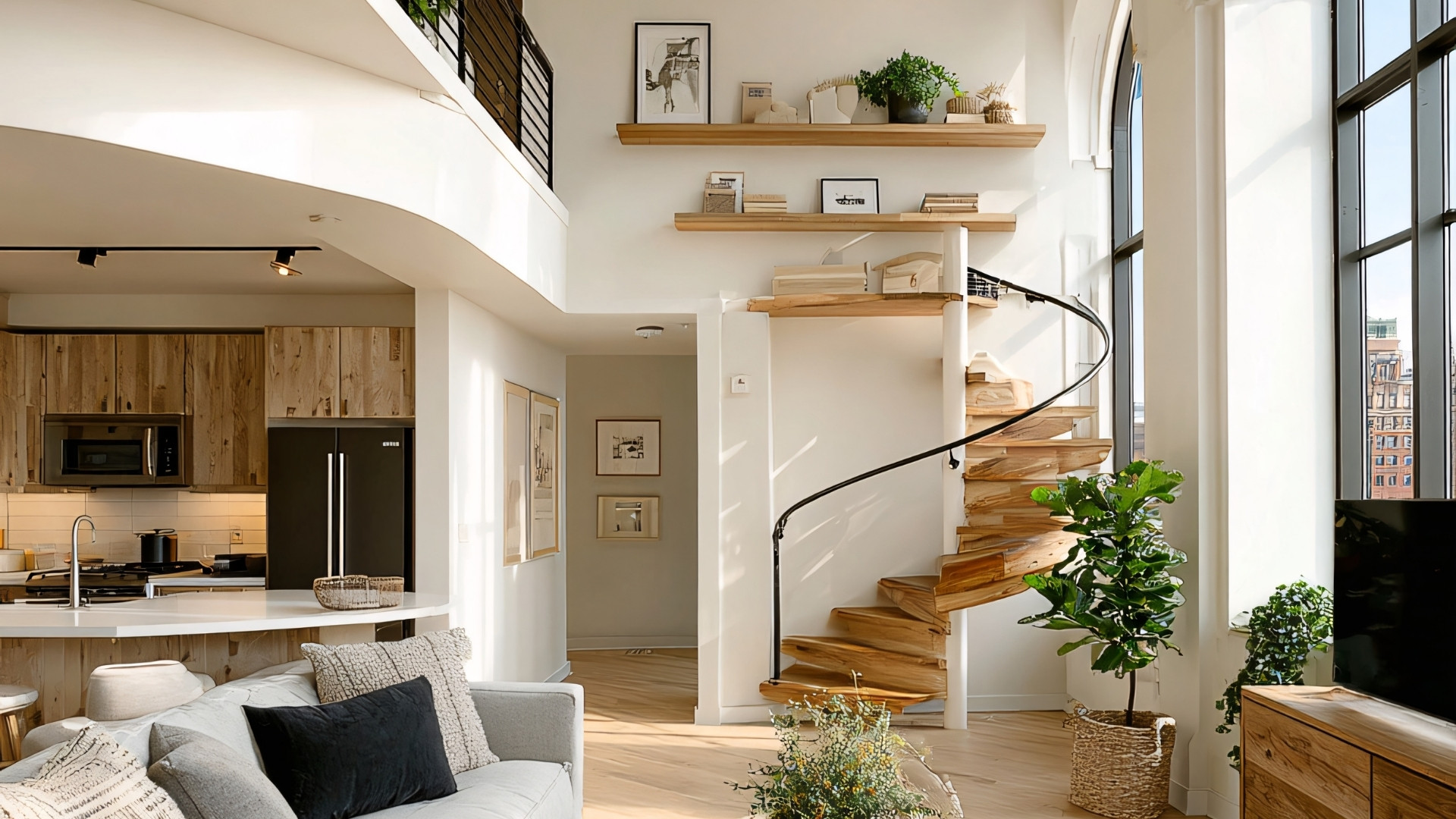
Painted or powder-coated steel center columns paired with solid hardwood treads in light oak, ash, or beech — this style balances industrial efficiency with organic warmth.
Material combinations:
- Light-colored hardwood treads (oak, ash, maple)
- White or light gray powder-coated steel frames
- Natural oil or clear-coat finishes on wood
- Minimal railing designs
- Emphasis on natural grain patterns
The Scandinavian spiral works in lofts with neutral palettes, natural light, and mixed-material furnishings. The wood treads soften the industrial steel structure while maintaining the clean lines that define contemporary loft design. Acadia Stairs offers multiple hardwood species including white oak, maple, and ash, all provided pre-sanded and ready for finishing.
Statement/Sculptural Spiral: Bold Design as Focal Point
In open-plan lofts where the spiral staircase remains visible from every angle, bold design choices transform functional infrastructure into art. Contrasting two-tone finishes, custom geometric balustrades, or integrated LED lighting make the staircase the room's defining feature.
Design strategies:
- Contrasting colors (white column with black treads, or vice versa)
- Custom railing patterns or materials
- Integrated LED tread lighting with dimming controls
- Oversized or sculptural handrails
- Mixed materials — steel, glass, or wood — for layered visual contrast
Acadia Stairs offers integrated LED lighting systems built directly into treads, featuring dimmable controls and tunable color temperature from warm to cool white. Two-tone finishes are easily achieved through their powder coating capabilities, allowing precise color matching to existing interior elements.
Rustic/Mixed-Media Spiral: Reclaimed Materials and Textured Finishes
The rustic spiral pairs reclaimed or textured wood treads with wrought iron or weathered steel columns. This approach suits lofts with exposed brick, vintage furniture, and eclectic aesthetics where contrast creates depth.
Material pairings:
- Reclaimed wood or distressed hardwood treads
- Oxidized or patina-finished steel frames
- Wrought iron or decorative metal railings
- Natural edge wood or rough-sawn lumber
- Mixed metal finishes (bronze, copper, blackened steel)
The contrast between raw metal and warm wood creates visual richness that complements lofts with layered, collected interiors. It's one of the few staircase styles that actually improves with age — patina and wear only add character.
Material and Finish Combinations to Match Your Loft Aesthetic
Steel and Metal: Structural Efficiency with Design Flexibility
Steel is the most structurally efficient choice for spiral staircase columns and frames, allowing slender profiles that support significant loads without visual bulk. Finish options dramatically change the aesthetic from raw industrial to refined contemporary.
Steel finish options:
- Matte black powder coat — Classic industrial appearance with scratch resistance
- Brushed nickel or stainless — Contemporary refinement with corrosion resistance
- Raw/oxidized steel — Authentic industrial character with natural patina development
- Galvanized — Maximum durability for harsh environments
- Custom colors — Precise matching to existing interior palettes
Powder coating creates a finish tougher than conventional paint, with increased resistance to scratches, chips, and corrosion. Acadia Stairs offers extensive powder coating options — working with Prismatic Powders, Tiger Drylac, and RAL color standards — so loft owners can match or contrast their existing palette precisely.
Wood Treads: Natural Warmth and Tactile Quality
Hardwood treads are the most popular complement to metal spiral frames in loft settings. Tread thickness, edge profile, and finish dramatically change the overall aesthetic.
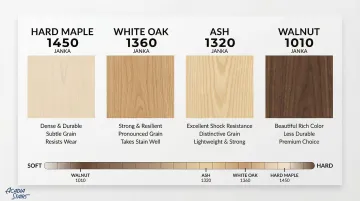
Hardwood species by characteristics:
- White Oak (1360 Janka hardness) — Excellent durability and resistance to wear
- Hard Maple (1450 Janka hardness) — Very hard with light color suited to Scandinavian styles
- Ash (1320 Janka hardness) — Strong with distinct grain pattern
- Walnut (1010 Janka hardness) — Rich dark color, softer but suitable for residential use
Match tread species and finish to existing flooring for visual cohesion. Acadia Stairs provides hardwood treads pre-sanded and ready for finishing, so you can apply stain or clear coat that precisely matches your loft's existing wood elements.
Glass Treads and Panels: Preserving Light and Openness
Tempered glass treads or glass railing panels allow light to pass through the staircase, preserving the airy, open feel that makes lofts desirable. This is most valuable in smaller lofts where a solid staircase would otherwise visually divide the space.
Glass specifications for safety:
- Laminated glass for treads — typically 3-ply, over 1 inch thick
- Tempered glass for railing panels
- Anti-skid surface treatments for tread safety
- Safety glazing meeting Category II standards
In multi-story lofts, the transparency also pulls natural light down to lower levels — something solid materials simply can't do.
Stainless Steel and Mixed Metal: Contemporary Refinement
Stainless steel handrails and cable or rod balustrades add high-end, contemporary finishes. Mixing metals — such as blackened steel frames with brushed stainless railings — adds dimension without clashing.
Mixed-metal combinations that work:
- Blackened steel frame with brushed stainless handrail
- Raw steel structure with polished stainless cable railing
- Powder-coated steel column with natural stainless hardware
- Bronze or copper accents on a steel base structure
Acadia Stairs offers #316 marine grade stainless steel components with multiple finish options — mill finish, #4 brush finish, and glass bead blasted surfaces — for precise coordination across different frame finishes.
Stone Treads: Monolithic Weight and Luxury
Stone or concrete treads — marble, slate, engineered stone — create monolithic, high-contrast looks suited to luxury lofts. These materials add significant weight, so floor opening load capacity needs structural review before specifying.
Stone options include:
- Granite for extreme durability
- Marble for luxury appearance
- Slate for textured, natural character
- Engineered stone for consistent color and pattern
Stone treads pair well with modern metal stringers, creating bold, sophisticated presence. Granite and marble treads can add 15–25 lbs per tread over wood — confirm your floor structure can handle the load before finalizing material selection.
Smart Space Planning Tips for Loft Spiral Staircases
Floor Opening Size and Placement
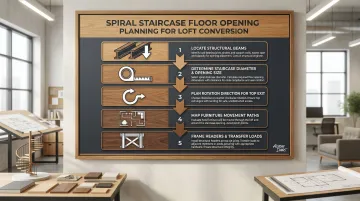
The most critical decision is where the spiral staircase lands on both floors. Structural beams determine where floor openings can be cut, often requiring engineering input for headers and load transfer.
Placement strategies:
- Position against a wall or in a corner to preserve central floor space
- Ensure the finished opening is 2+ inches larger than staircase diameter
- Plan rotation direction (clockwise vs. counterclockwise) so the top exit faces an open area
- Account for furniture movement paths around the base
- Verify joist direction and header requirements before cutting
A 5-foot diameter spiral requires a minimum 62-inch by 62-inch finished opening. When floor joists must be cut, headers must transfer the load to adjacent trimmer joists, potentially requiring doubled or tripled framing members.
Ceiling Height and Rise
Lofts with standard 9-10 foot ceiling heights need spirals with enough rise to clear head height comfortably at the exit point. IRC code requires minimum 6 feet 6 inches headroom measured vertically from the leading edge of the tread.
Height considerations:
- Taller mezzanines (12+ feet) benefit from spiral's vertical efficiency
- More treads create gentler, safer incline
- Verify local code requirements for residential egress
- Account for finished floor materials in rise calculations
In taller lofts, this vertical efficiency is a genuine advantage — more rise, same footprint. That spatial economy also shapes how the base area gets used.
Under-Stair Space Utilization
Unlike straight stairs, the area beneath a spiral isn't a usable cavity. However, the circular footprint can be designed around to make the staircase feel intentional as a room anchor.
Design strategies:
- Surround the base with built-in shelving
- Create a reading nook with curved seating
- Add potted plants in an arc around the perimeter
- Use the circular form as a room divider between zones
- Install accent lighting to highlight the sculptural form
Tread Depth and Safety in Loft Context
Once you've planned the footprint and base area, tread depth becomes the next critical variable. Spiral treads are narrower at the center pole and wider at the outer edge — so diameter directly determines how comfortable each step feels. For loft staircases used daily, a wider diameter meaningfully improves safety.
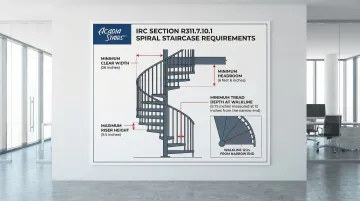
Code requirements per IRC Section R311.7.10.1:
- Minimum clear width: 26 inches at and below handrail
- Minimum tread depth: 6.75 inches at the walkline (12 inches from narrow edge)
- Maximum riser height: 9.5 inches
- Minimum headroom: 6 feet 6 inches
A 5-6 foot diameter spiral provides deeper outer tread depth than a compact 3.5-foot model, improving comfort for daily use. Choosing a larger diameter often resolves tread depth minimums in a single decision — making it one of the most code-efficient upgrades available during the planning stage.
Railing and Balustrade Ideas That Elevate the Design
Steel Rod Balustrades: Classic Versatility
Wrought iron or steel rod balustrades are the classic choice for spiral staircases. Vertical rod spacing, rod thickness, and finish all vary and can be customized to match the staircase's design language.
Design variables:
- Rod diameter (1/2 inch to 3/4 inch typical)
- Spacing (must prevent passage of 4-inch sphere per code)
- Finish (powder coat, raw steel, blackened, brushed)
- Pattern (straight vertical, twisted, decorative)
For loft settings, a blackened or raw steel finish pairs well with exposed brick or concrete, while a brushed or powder-coated finish suits cleaner contemporary interiors.
Cable Railing Systems: Modern Transparency
Cable railing systems feature horizontal stainless steel cables tensioned between posts, maintaining sightlines and keeping the loft feeling open. This works particularly well when paired with wood or metal handrails in contemporary or industrial aesthetics.
Cable system specifications:
- #316 marine grade stainless steel cables for corrosion resistance
- 3-inch on-center spacing to account for deflection and ensure 4-inch sphere rule compliance
- 70-200 lbs tension per cable
- Swaged end fittings, sized and cut to fit the specific run
Custom fabricators can match cable hardware finishes — natural stainless, blackened patina, or powder-coated color — to the handrail and tread materials already specified for the staircase.
Glass Panel Balustrades: Maximum Visual Transparency
Glass panel balustrades — frameless or minimally framed — are the most visually transparent option, ideal for compact lofts where every visual inch of space matters.
Glass railing benefits:
- Unobstructed light transmission
- Clean, contemporary aesthetic
- Etched or frosted options for mezzanine privacy
- Laminated safety glass prevents fall-through if broken
- Minimal visual interruption of sight lines
Glass panels work especially well in lofts with statement views or feature walls — keeping the staircase functional without drawing the eye away from the space itself.
What to Budget for a Loft Spiral Staircase
Spiral staircase costs vary widely based on diameter, materials, custom versus prefab, and installation complexity. Most loft projects land between $5,000 and $25,000+ once installation is included.
Staircase Unit Costs
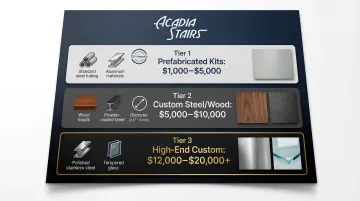
| Staircase Type | Price Range | Description |
|---|---|---|
| Prefabricated Kits | $1,000 - $5,000 | Standard steel or aluminum kits; DIY-friendly; limited finishes |
| Custom Steel/Wood | $5,000 - $10,000 | Mid-range custom units; wider diameter; wood treads; powder coat finishes |
| High-End Custom | $12,000 - $20,000+ | Fully custom designs; premium materials (stainless steel, glass, exotic wood) |
Installation and Site Preparation Costs
The staircase unit is only part of the total spend. Budget for these additional costs:
- $1,000–$3,000 for floor opening cutting and structural framing
- $2,000–$10,000+ for installation labor, depending on access and complexity
- $100–$600 for permits and building department inspections
- $500–$2,000 for landing edge trim, drywall repair, and paint
- $300–$800 for integrated LED lighting, if included
Working with a single manufacturer that handles design, fabrication, and engineering in-house — as Acadia Stairs does — tends to reduce total project costs. Fewer handoffs between architects, fabricators, and contractors means fewer miscommunications and mid-project revisions.
Frequently Asked Questions
What is the average cost of a spiral staircase?
Spiral staircase costs range from $1,000-$5,000 for prefab kits to $12,000-$20,000+ for fully custom metal staircases. Installation, structural modifications, and material choices (wood treads, glass panels, custom finishes) are the biggest cost variables.
What is the minimum floor space needed for a spiral staircase in a loft?
Standard spiral diameters range from 3.5 to 6 feet, with a 5-foot diameter being the practical minimum for comfortable daily use in a residential loft. This requires a finished floor opening of approximately 62 inches by 62 inches, occupying roughly 26 square feet.
Are spiral staircases up to building code in apartments?
Spiral staircases can meet residential building codes when properly designed. IRC Section R311.7.10.1 requires minimum 26-inch clear width, 6.75-inch tread depth at the walkline, and maximum 9.5-inch riser height. A licensed contractor or architect should confirm local compliance before installation.
What materials work best for a spiral staircase in a modern loft?
Steel frames with wood or glass treads are the most popular combination in modern lofts. Powder-coated steel offers color flexibility and corrosion resistance, while hardwood treads add warmth and glass treads maximize light and openness.
Can a spiral staircase be fully customized to match my loft's interior?
Yes. Custom spiral staircases can be built to specific dimensions, finishes, tread materials, and railing styles — making it possible to match virtually any interior. Powder coating, hardwood species selection, and custom railing configurations are the most common tools for achieving a cohesive look.
Do spiral staircases add value to a loft apartment?
A well-designed spiral staircase can serve as a selling point by enhancing architectural character and adding usable square footage through mezzanines or attic conversions](https://www.nar.realtor/research-and-statistics/research-reports/remodeling-impact). That said, an overly steep or poorly executed spiral may put off buyers who value daily practicality as much as design.