Introduction
Picture this: you step into a grand entryway and stop mid-stride, captivated by a staircase so striking it commands the entire space. Two intertwined helical ramps spiral upward around a shared axis, creating a sculptural form that connects centuries of architectural history to modern custom fabrication. The double spiral staircase has mesmerized visitors from Renaissance châteaux to modern luxury homes.
For most people, double spiral staircases exist only in castles or museums. That's changed. Advances in metal fabrication, structural engineering, and custom design now make this iconic form achievable in residential foyers and commercial lobbies alike.
This guide covers everything you need to know: how the double spiral works mechanically, its fascinating history, why it remains a compelling choice for modern spaces, and how to bring one to life in your project.
TLDR:
- Double spiral staircases feature two separate helical ramps wound around a shared axis, allowing simultaneous ascent and descent without paths crossing
- Famous examples include Château de Chambord (1519) and the Vatican Museums' Bramante Staircase (6.7 million annual visitors)
- They deliver architectural drama, improved traffic flow, and space efficiency compared to traditional dual staircases
- Custom fabrication requires specialized engineering, quality materials (steel, stainless steel, aluminum), and code-compliant design
- Acadia Stairs designs and ships custom staircases nationwide, with over 40 years of combined fabrication experience
What Is a Double Spiral Staircase?
A double spiral staircase consists of two separate helical staircases wound around a shared central axis, designed so the two paths never intersect. This allows people to ascend and descend simultaneously without ever crossing paths—a remarkable feat of geometric precision that has captivated architects for over 500 years.
How the Geometry Works
Each staircase follows its own spiral path around a hollow central column or open core. Landings at each floor level allow users to step on or off either path. Carved or latticed balustrades let people on both paths see each other while remaining physically separated—the two ramps intertwine like a DNA strand, creating visual drama with complete functional independence.
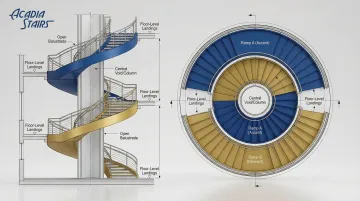
The central void serves three functions:
- Provides structural support through a hollow column
- Creates sightlines between the two paths
- Frames decorative elements—lantern towers or skylights—that illuminate the vertical space
Terminology Clarification
Several terms refer to this same structural concept:
- Double spiral staircase
- Double-helix staircase
- Twin spiral staircase
- German: Zwillingswendeltreppe or Doppelwendeltreppe
These terms are used interchangeably in architectural literature. "Double-helix" has become the most widely recognized term outside Germany, largely because of its association with DNA—useful context when searching historical sources or specifying the design with a fabricator.
Distinguishing from Similar Designs
The Museo do Pobo Galego in Santiago de Compostela takes the concept further with a triple-helix staircase—three intertwined ramps designed c. 1700 by Domingo de Andrade. That structure is significantly more complex and structurally distinct from a double spiral.
A standard spiral staircase, by contrast, features a single helical path around a central pole. The double spiral doubles the circulation capacity and delivers far greater visual impact, though it requires a larger diameter and more sophisticated engineering.
Famous Double Spiral Staircases Through History
Château de Chambord (France, 1519)
The most iconic example stands at the heart of Château de Chambord in France's Loire Valley. Two ramps wind four floors without intersecting, positioned at the château's very center beneath a magnificent lantern tower. The design allows two people to climb opposing staircases simultaneously—seeing each other through open windows in the central core—without ever meeting.
The enduring debate centers on Leonardo da Vinci's possible involvement. Several details point to his influence:
- Construction began in 1519, coinciding with da Vinci's residency at the nearby court of King Francis I
- No architectural plans survive, but the staircase closely mirrors helical tower sketches in his Codex Atlanticus
- The geometry reflects da Vinci's documented interest in double-helix structures
Vatican Museums' Bramante Staircase (1932)
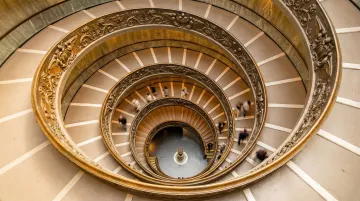
The famous double-helix staircase at the Vatican Museums was designed by Giuseppe Momo in 1932—not by Donato Bramante, despite its common name. (Bramante's original 1505 stair is a separate single-ramp structure.) Momo's design features twin spirals: one ascending, one descending, twisted together in perfect harmony.
This staircase demonstrates that the double spiral is not purely decorative but functionally superior in high-traffic environments. The Vatican Museums recorded 6.7 million visitors in 2023, with this staircase serving as the main exit route. Its ability to separate counter-flowing crowds eliminates bottlenecks and prevents collision points—an elegant solution to a very real crowd-flow problem.
Grazer Burg Double Spiral (Austria, c. 1499)
Known locally as the Versöhnungsstiege (Staircase of Reconciliation), this late Gothic masterpiece in Graz, Austria features two opposing spiral stairs that merge briefly on each floor before parting again. The romantic legend holds that "if you go separate ways, you will reunite," symbolizing eternity and reconciliation.
A pair climbing together can separate on one floor and find each other again on the next. Few staircases have turned a structural mechanism into a metaphor quite so deliberately.
Why Choose a Double Spiral Staircase?
Architectural Drama and Sculptural Identity
The intertwining forms create a centerpiece that functions as both structure and art—a focal point quality that conventional straight or single-spiral stairs cannot replicate. Zillow research found that homes with statement design features can sell for 3.5% more than expected, with architectural staircases serving as "visual anchors" that set the tone for the entire property.
Double spiral staircases command attention the moment someone enters a space. Few architectural features stop visitors mid-step the way a paired helix does — it reads as sculpture first, staircase second, and that impression sticks with buyers long after a showing ends.
Traffic Flow and Dual Functionality
The practical benefit shines in spaces with regular two-way movement:
- Grand entryways where guests arrive as residents depart
- Commercial lobbies managing employee and visitor flow
- Multi-family residences with high-density traffic patterns
- Museums and cultural institutions handling massive visitor volumes
Separating ascent and descent keeps traffic moving without requiring a wider footprint than a single spiral. The Vatican example proves this design can handle extreme traffic loads while maintaining elegant proportions.
Space Efficiency Relative to Impact
A traditional side-by-side dual staircase requires double the floor area — one complete stairwell per direction. A double spiral achieves the same two-directional function within a single circular footprint.
It does need a larger diameter than a single spiral, but it's still far more space-efficient than running two separate straight staircases.
This makes the design viable even where space is at a premium, particularly in:
- Interior courtyards or atriums (where vertical space is abundant but floor area is limited)
- Library lofts (connecting reading levels with sculptural elegance)
- Poolside terraces (linking deck levels while maintaining sightlines)
- High-end commercial lobbies (maximizing floor space for revenue-generating uses)
Investment Value and Resale Impact
Custom architectural staircases signal quality craftsmanship and design sophistication. Real estate professionals note that statement staircases create emotional connections with buyers, potentially shortening time on market by creating memorable impressions during showings.
In luxury markets especially, a double spiral does something generic finishes cannot: it gives a property a feature that's genuinely difficult to replicate, which is the kind of differentiation that holds value over time.
Double Spiral vs. Single Spiral: Key Differences
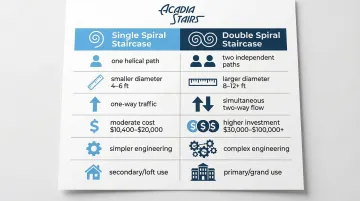
| Feature | Single Spiral Staircase | Double Spiral Staircase |
|---|---|---|
| Usable Paths | One helical ramp | Two independent helical ramps |
| Visual Impact | Compact, minimal footprint | Sculptural, grand, dramatic |
| Traffic Capacity | One-way at a time | Simultaneous two-way flow |
| Diameter Required | Smaller (typically 4-6 feet) | Larger (typically 8-12+ feet) |
| Structural Complexity | Single stringer, simpler engineering | Dual stringers, complex geometry |
| Installation | Moderate difficulty | High complexity, specialized fabrication |
| Typical Cost | $10,400-$20,000 average | $30,000-$100,000+ |
| Best Use Cases | Secondary access, lofts, small spaces | Primary staircases, grand homes, commercial settings |
When to Choose a Single Spiral
A single spiral is the better choice when:
- Budget constraints require cost-effective solutions
- Space is extremely limited (tight footprint)
- Traffic patterns are simple and low-volume
- It serves secondary or occasional access, not the home's main path
- Simpler installation and maintenance are priorities
When to Choose a Double Spiral
The double spiral justifies its complexity when:
- High-traffic primary staircase requires two-way flow
- You want a statement piece that defines the entire space
- Commercial applications with significant visitor volumes
- Larger floor plans can accommodate the required diameter
- Budget supports a higher upfront investment for a lasting architectural feature
Double spirals require more engineering, more material, and custom fabrication — which explains the price gap. That investment buys you something a single spiral can't: a staircase that functions as a primary traffic path and a defining architectural feature in one structure.
Design, Materials, and Customization Options
Material Choices for the Structure
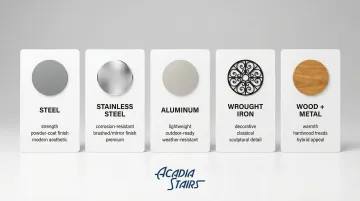
Steel: Offers exceptional strength with a clean modern aesthetic. Available in rectangular tubes, channels, round tubes, and fabricated I-beams. Can be finished with hot-dipped galvanized coating for corrosion resistance or powder-coated in virtually any color. Steel provides the structural integrity needed for complex double spiral configurations.
Stainless Steel: The premium choice for maximum durability and a contemporary look. Available in #304 and #316 marine-grade specifications, with brushed, mill, glass bead blast, and mirror finishes. Ideal for high-end residential and commercial applications where minimal maintenance and long-term appearance matter.
Aluminum: Lightweight yet strong, making it ideal for outdoor installations or projects with shipping and weight constraints. Weather-resistant with sandblasted, primed, or powder-coated finishes. The reduced weight simplifies complex helical configurations without sacrificing structural integrity.
Wrought/Forged Iron: Provides classical detail and ornamental flexibility for traditional or transitional designs. Allows for decorative spindles, sculptural elements, and custom patterns that add historical character to the double spiral form.
Wood Combined with Metal: Adds warmth and texture through hardwood treads or decorative elements while maintaining metal's structural advantages. Popular species include Red Oak, White Oak, Maple, Cherry, Mahogany, and Walnut.
Railing and Balustrade Styles
The choice between railing styles dramatically shifts visual character:
Cable Rails: Create clean, modern lines with minimal visual obstruction. Particularly important in double spirals where open sightlines between the two paths enhance the design's drama. Custom swaged threaded rod terminals using #316 marine-grade stainless steel provide strength and contemporary elegance.
Glass Panels: Offer sleek, transparent barriers that let the steps take center stage. Glass maintains safety while preserving the sculptural quality of the intertwined ramps. Anti-skid surfaces can be added for safety.
Ornamental Iron Balusters: Provide classical detail and decorative flexibility. Custom patterns and spindle designs add visual interest while maintaining the open-work quality essential to double spiral designs.
Solid Steel Rails: Deliver industrial-modern character with maximum durability. Can be powder-coated in custom colors to complement or deliberately contrast with surrounding design.
The open-work design of balustrades is particularly important in double spirals—it preserves sightlines between the two paths, allowing the geometric interplay to remain visible and creating the visual connection that makes the design so compelling.
Finish and Coating Options
Powder coating adds durability, weather resistance, and unlimited color customization. The process involves electromagnetic spray application followed by high-temperature curing (385°F minimum) that creates a molecular-level bond resistant to chipping, peeling, and fading.
Benefits include:
- Protection against moisture, rust, and corrosion
- Weather resistance for outdoor installations (including coastal environments)
- Custom color matching to any palette (Prismatic Powders, Tiger Drylac, RAL Colors)
- Finish options: matte, gloss, textured, metallic, or custom blends
- Minimal maintenance—just occasional rinsing maintains appearance for years
Tread Options
Hardwood Treads: Add warmth and texture with species like Oak, Maple, Cherry, Mahogany, or Walnut. Delivered pre-sanded and ready for staining or polyurethane finishing. Ideal for residential applications prioritizing comfort and traditional aesthetics.
Steel Pan Treads: Prioritize durability and safety with options including smooth plate, diamond plate, perforated plate, or textured surfaces. Anti-slip surfaces provide traction in high-traffic or outdoor applications.
Glass Treads: Create a floating, light-filled effect with laminated glass featuring diamond pattern tops or anti-skid surfaces. Offer timeless elegance and high-end appeal, particularly effective in double spirals where light can filter through both ramps.
Stone and Premium Materials: Bluestone, granite, ceramic tile, or pre-cast concrete provide exceptional durability and luxury aesthetics for high-end installations.
Bringing Your Double Spiral Vision to Life
With the full range of materials, finishes, and railing styles outlined above, the real question is execution — finding a manufacturer with the precision engineering and collaborative design capability to handle a double spiral's inherent complexity.
Acadia Stairs has built staircases for nearly every circumstance since 2011, drawing on 40+ years of combined team experience. Their process is structured to handle ambitious projects from the start:
- 3D renderings provided before fabrication begins
- Detailed shop drawings submitted for code review
- Pre-assembly in their Fishkill, NY shop to verify fit before shipping
- Systematic breakdown into manageable sections for nationwide delivery
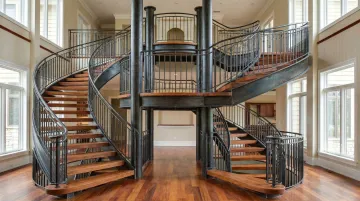
Material options span steel, stainless steel, aluminum, and decorative iron, with comprehensive powder coating and extensive tread and railing customization. Whether you're an architect working through a complex site constraint or a homeowner with a specific design vision, Acadia works alongside you to get it built right.
Building Codes and Practical Considerations
Legal Requirements for Spiral Staircases
Spiral staircases are legal in the US under the International Residential Code (IRC) and International Building Code (IBC), subject to specific requirements:
IRC 2021 Requirements (Residential):
- Minimum clear width: 26 inches at and below the handrail
- Tread depth: Minimum 6¾ inches at the walkline (located 12 inches from narrow edge)
- Maximum riser height: 9½ inches
- Minimum headroom: 6 feet 6 inches
- Egress restriction: Permitted as means of egress only within dwelling units or for spaces ≤250 sq. ft. serving ≤5 occupants
IBC 2021 Requirements (Commercial): Commercial codes impose stricter limitations:
- Permitted as egress only within dwelling units or from spaces ≤250 sq. ft. serving ≤5 occupants
- In large commercial lobbies or museums, a double-helix is typically classified as a "monumental stair" or "convenience stair" rather than required egress
Code Compliance and Municipal Variations
Code requirements vary by state and municipality, and commercial applications face stricter standards than residential projects. Working with a fabricator who builds code compliance into the specification process from the start saves significant time and cost.
Acadia Stairs provides shop drawings tailored to each order, which clients can share with local building departments before fabrication begins. With projects completed in every US state, their design consultants know how to navigate jurisdiction-specific requirements.
Structural Engineering Considerations
The double spiral requires robust engineering:
- Central column load: The core must carry the combined weight of two staircases, requiring precise calculation of cumulative forces and specialized structural analysis.
- Six internal actions: Helical stairs experience vertical and horizontal moments, vertical and lateral shear, axial force, and torsion. Engineers often model them as "fixed ended curved beams" for design purposes.
- Foundation and ceiling attachment: Both connection points must handle combined loads from both ramps, with lateral moment reinforcement for the unique twisting forces involved.
Bring a structural engineer into the process early, ideally someone with helical torsion experience. Standard load tables often don't account for twin-ramp configurations.
Frequently Asked Questions
What is a double spiral staircase?
A double spiral staircase consists of two separate helical staircases wound around a shared central axis, allowing people to ascend and descend simultaneously without crossing paths. The two ramps intertwine in opposite helical paths while remaining physically separated through precise geometric design.
Are spiral staircases legal in the US?
Yes, spiral staircases are legal under the IRC and IBC, subject to specific requirements for tread depth (minimum 6¾ inches at walkline), riser height (maximum 9½ inches), headroom (minimum 6'6"), and minimum diameter. Local codes may add further conditions, and commercial applications face stricter egress limitations.
How does a double spiral staircase work mechanically?
The two ramps twist around a hollow central column, each with its own landings at each floor level. The open balustrade design lets users see each other through the central void while the ramps remain entirely separate — two independent paths sharing one structural core.
What materials are best for a double spiral staircase?
Steel and stainless steel are the most common structural choices, with stainless steel adding corrosion resistance and a high-polish finish. For outdoor installs, aluminum is a practical alternative. Wood treads, glass panels, or iron balustrades can be layered in depending on the aesthetic.
Can a double spiral staircase increase home value?
Double spiral staircases are recognized by real estate and design professionals as features that elevate property desirability among luxury buyers. Distinctive custom staircases can command sale premiums and reduce time on market.
The double spiral staircase has anchored landmark buildings for over 500 years — and it works just as well in a modern residential entryway or commercial lobby. With the right fabrication partner and code-compliant engineering, this design is more accessible than most people expect.