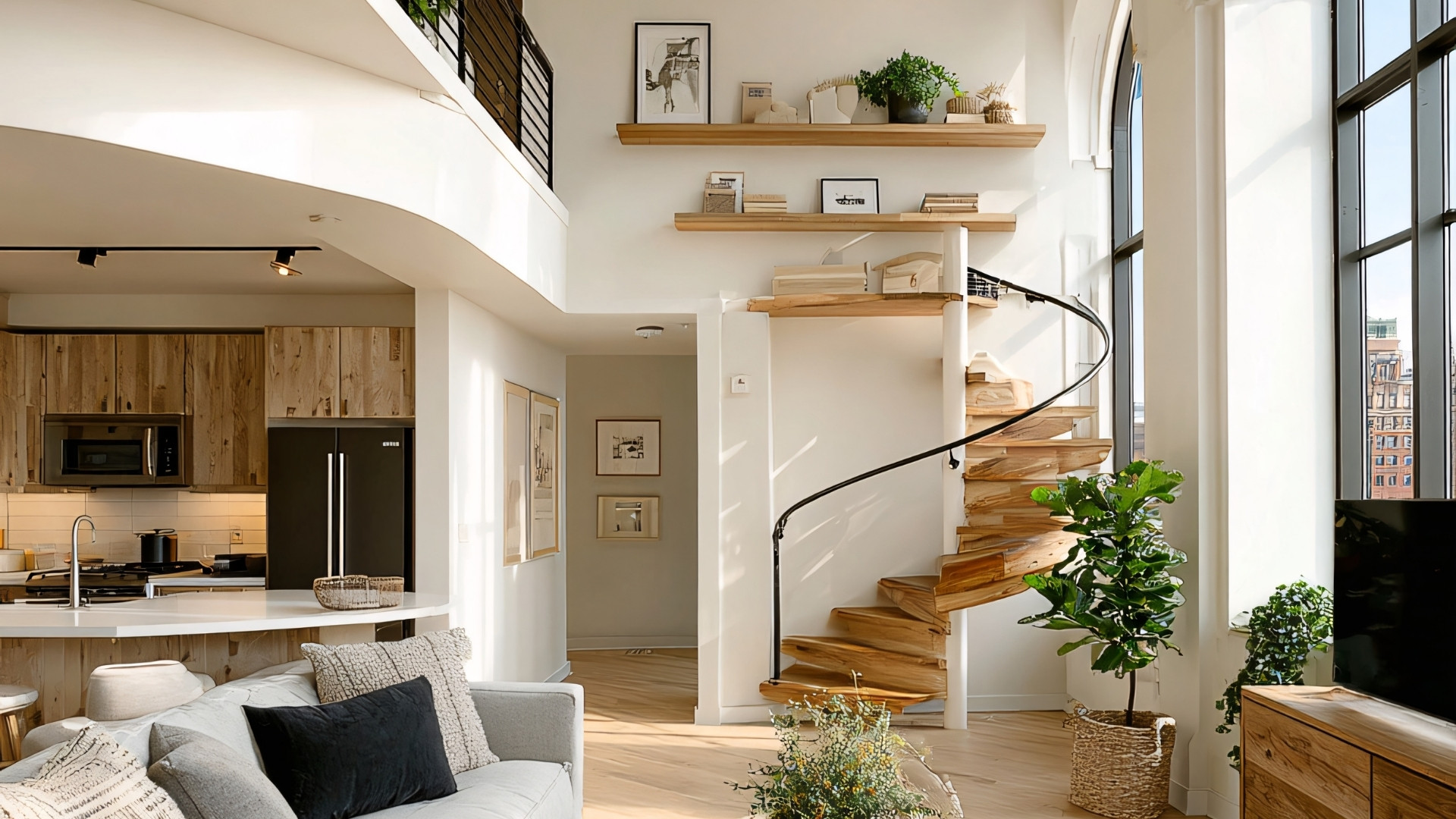
When space is limited, a spiral staircase often seems like the perfect solution. Its compact design promises to save valuable floor area while still providing functional access between levels. However, as many soon discover, the reality of installing a spiral staircase can come with unexpected challenges, ranging from restricted furniture access to more stringent inspections. In these situations, the seemingly ideal spiral may turn into a costly and time-consuming headache.
This blog explores 6 practical alternatives to spiral staircases, offering a variety of engineered stair options that balance space efficiency with code compliance and long-term usability.
Key Takeaways
Spiral staircases often create usability, inspection, or fabrication issues even when they meet basic code requirements.
Common spiral staircase alternatives include curved or helical stairs, U-shaped stairs, straight mono-stringer stairs, winders in limited cases, and ship ladders for secondary access only.
Landing-based and uniform-tread stair systems, such as U-shaped and straight stairs, support easier furniture movement and more predictable approvals.
The right alternative depends on stair use, available space, and fabrication capability, not footprint alone.
Early selection of the stair type helps reduce redesigns, inspection comments, and construction delays.
Why Spiral Staircases Are Often Reconsidered?
Spiral staircases are often chosen to save space. In practice, they’re also one of the most commonly revised stair types once a project moves beyond layout sketches.
Common reasons include:
Limited use as primary egress: Spiral stairs are usually restricted to secondary or limited-use applications under IRC and IBC. Narrow walking lines and reduced clear width often disqualify them from required egress.
Uneven and tiring to walk: Tread depth increases toward the outside edge, forcing users onto an inconsistent walking path that becomes uncomfortable with daily use.
Handrail compliance issues: Curvature and center columns make continuous, graspable handrails difficult. Handrail geometry is a frequent inspection issue.
Poor furniture and equipment access: Tight turning clearance makes moving furniture or appliances difficult, often discovered after design approval.
Higher inspection risk: Spiral stairs are subject to closer review for tread depth, riser uniformity, headroom, and handrails. Issues often surface late.
Fabrication and installation sensitivity: Tight tolerances and curved components leave little room for error. Small deviations can require shop or site revisions.
Changing expectations over time: The compact footprint looks appealing early, but usability and safety concerns often change client decisions later.
Because of these factors, spiral staircases are often treated as a situational solution rather than a default choice. If you are also evaluating spiral staircase alternatives, then it is best to contact experienced fabricators such as Acadia Stairs to review spiral staircase alternatives before your stair selections are finalized.
6 Engineered Spiral Staircases Alternatives That You Can Use In 2026
When spatial constraints eliminate conventional straight-run stairs, and spirals introduce unacceptable functional limitations, several engineered configurations provide reliable middle-ground solutions.
Here are some of the most popular alternatives for spiral staircases:
1. Curved and Helical Stairs

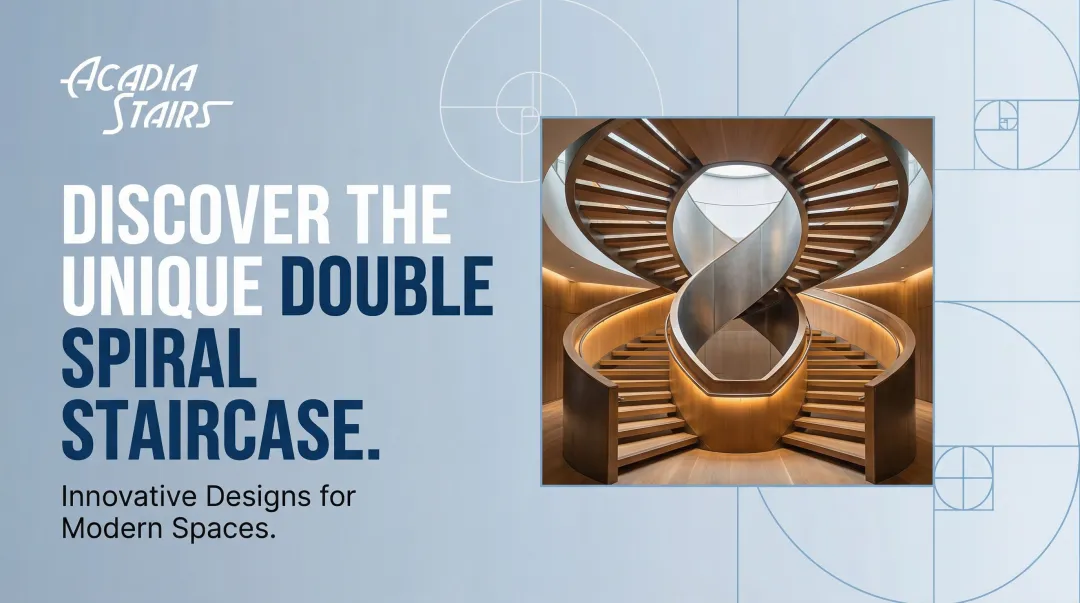
Curved and helical stair systems replace the central column of spiral stairs with curved structural supports, allowing smooth directional changes without extreme tread taper.
A curved stair follows a broad arc, typically with a radius exceeding 5 feet, allowing treads to maintain a relatively consistent depth across the walking line. A helical stair follows a tighter circular path, often rotating 180 degrees or more, but similarly eliminates the center pole by supporting treads on curved stringers.
Under both the International Residential Code (IRC) and International Building Code (IBC), curved and helical stairs that meet standard riser height and tread depth requirements are treated as conventional stairs rather than spiral stairs.
Why curved and helical stairs work as spiral alternatives:
Consistent tread geometry: Usable tread depth is maintained across the stair width, typically meeting the 10-inch minimum required under IRC Section R311.7.5.2.
Improved daily usability: A wider turning radius and uniform walking line reduce fatigue and improve safety for primary circulation.
Better movement between floors: The absence of a center column and reduced tread taper allow furniture and equipment to move more easily.
Clear structural load transfer: Loads are distributed through curved stringers rather than concentrated at a single central pole.
Fewer spiral-specific code limitations: Standard stair provisions apply, reducing inspection sensitivity compared to spiral configurations.
Fabrication and coordination considerations:
Curved and helical stairs require steel bending or rolling, precise tread layout, and tightly coordinated shop drawings. Structural design must address torsional forces and lateral stability in curved members. Although fabrication complexity and lead times are higher than for spiral stairs, these systems offer improved usability and approval reliability in U.S. residential and commercial projects.
2. U-Shaped (Switchback) Stairs
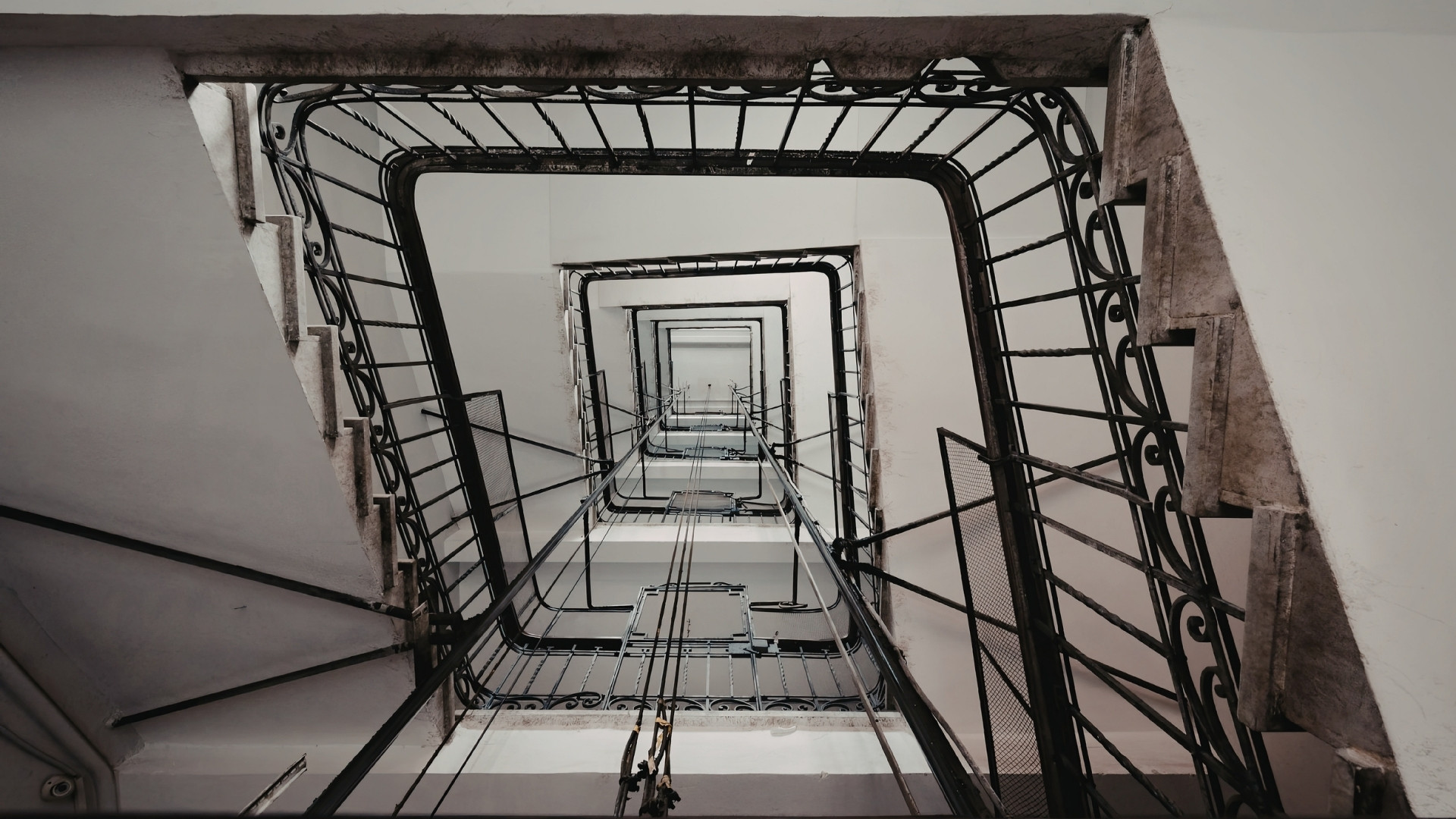
U-shaped stairs use two straight flights, separated by a 180-degree turn at an intermediate landing. This achieves the same vertical rise as a spiral within a compact rectangular footprint while maintaining conventional geometry.
Under both IRC Section R311.7 and IBC Chapter 10, U-shaped stairs are classified as conventional stairs. There are no occupancy restrictions or special provisions limiting where they can be used.
Why U-shaped stairs work:
Full-size landing at the direction change allows furniture to be pivoted, eliminating movement restrictions.
Tread depth and riser height comply with standard code requirements without exception.
Structural loads are clearly transferred through the individual flights and the landing.
Shop drawings are easier to produce than spiral radial layouts.
Fabrication uses standard straight stair methods familiar to most metal shops.
Design and coordination considerations
U-shaped stairs require more floor area than spiral stairs.
Landing size and headroom must be verified early to avoid framing conflicts.
Structural loads are transferred through the landing, which requires clear support detailing.
3. Straight Linear Stairs and Mono-Stringer Systems
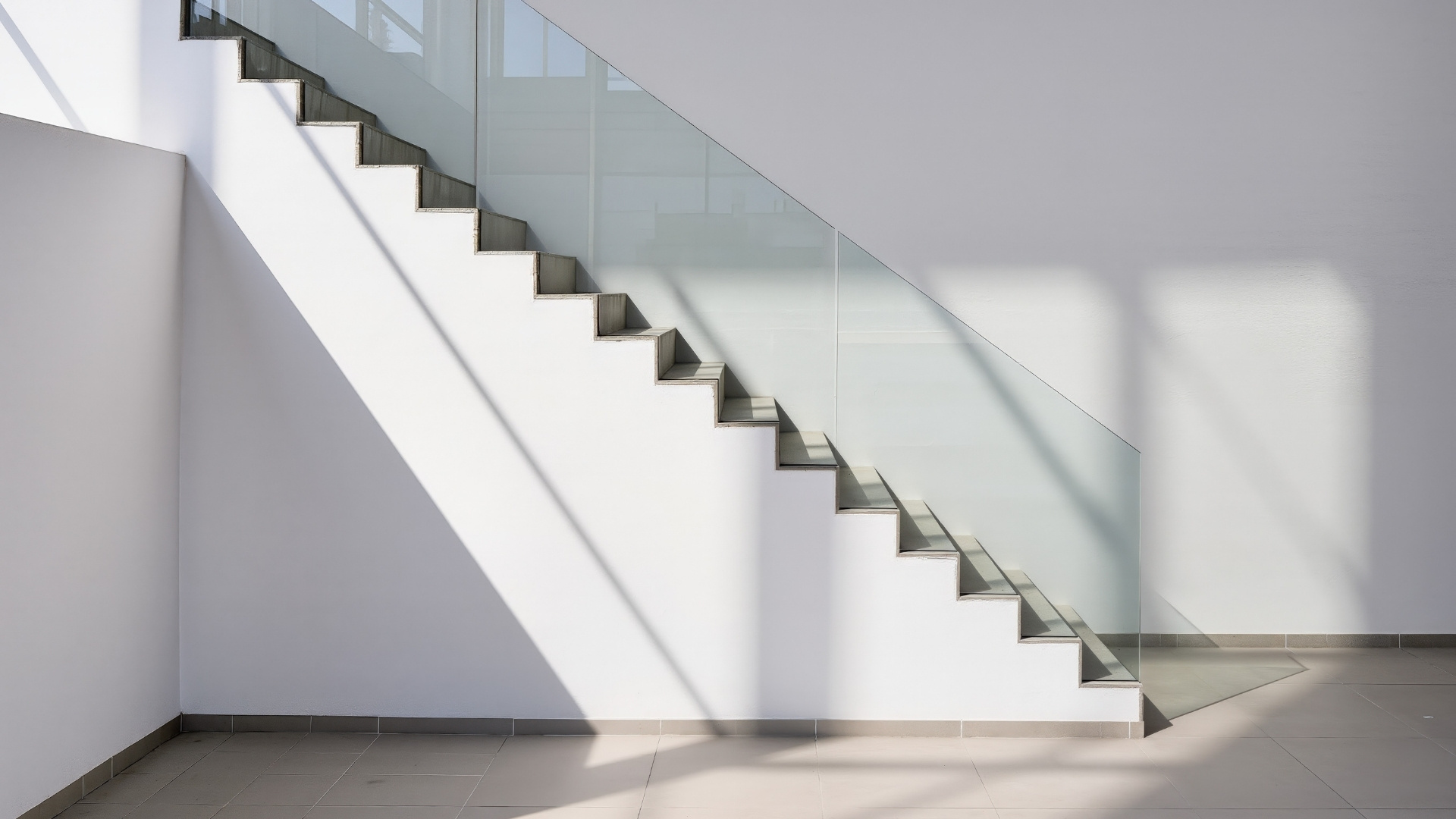
When sufficient horizontal run is available, straight linear stairs eliminate directional complexity entirely. Modern mono-stringer systems maintain visual lightness and contemporary appearance while providing dramatically better usability.
A mono-stringer stair uses a single central structural beam to support treads from below or from the side. Treads appear to float without visible side stringers, creating an open, minimalist appearance.
Why straight mono-stringer stairs work:
Treads maintain consistent depth across the full width.
Structural engineering is straightforward with clear vertical load paths.
Furniture and materials move easily without turning constraints.
Fabrication tolerances are significantly more forgiving than spirals.
Code compliance follows standard stair provisions under IRC Section R311.7.
Design considerations
Horizontal run: Verify available run early to avoid steep pitches or late layout changes.
Deflection: Exposed mono-stringers benefit from tighter deflection limits to reduce movement.
Tread weight: Material and thickness affect stringer sizing and connections.
Railing coordination: Guard attachment points should be resolved before fabrication.
Headroom: Check clearance along the full run, especially near ceiling transitions.
4. Winder Stairs (Where Code Allows)
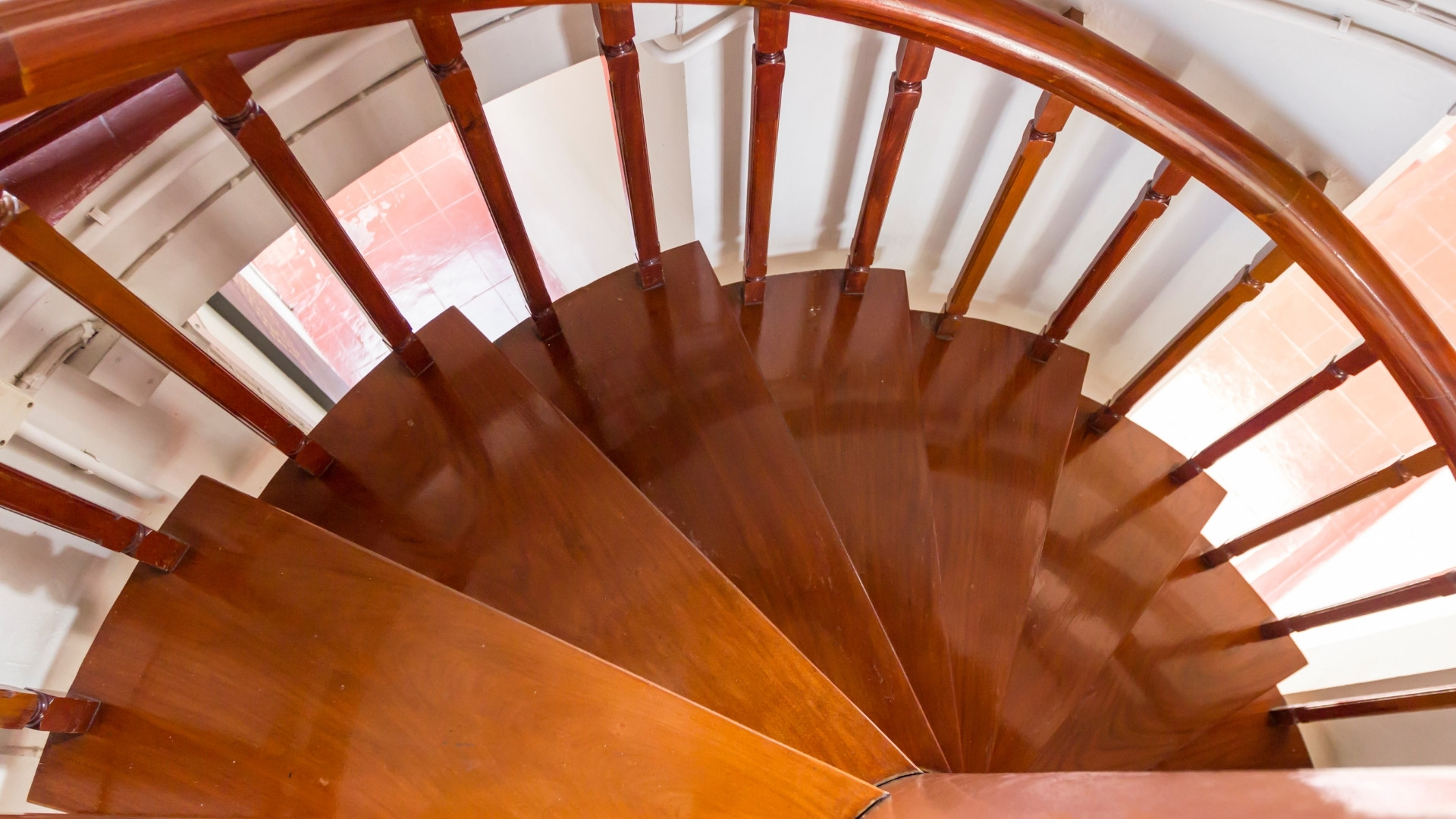
Winder stairs are often considered when a spiral stair is rejected, but a full landing will not fit the available footprint.
Instead of a landing, winders use tapered treads to change direction. This reduces space use but introduces tighter tolerances and higher review scrutiny.
In U.S. projects, winders are permitted only when the tread depth at the walking line meets code. This is where most projects encounter issues.
IRC winder requirements:
Minimum 10-inch tread depth at walkline, measured 12 inches from narrow edge.
Minimum 6-inch tread depth at any point along the tread.
Variation in tread depth at the walkline cannot exceed 3/8 inch.
Design Considerations
Shop drawings must clearly show walking-line dimensions.
Small dimensional changes often require redraws.
Winders are less forgiving of dimensional variation than landing-based stairs.
5. Ship Ladders and Alternating Tread Stairs
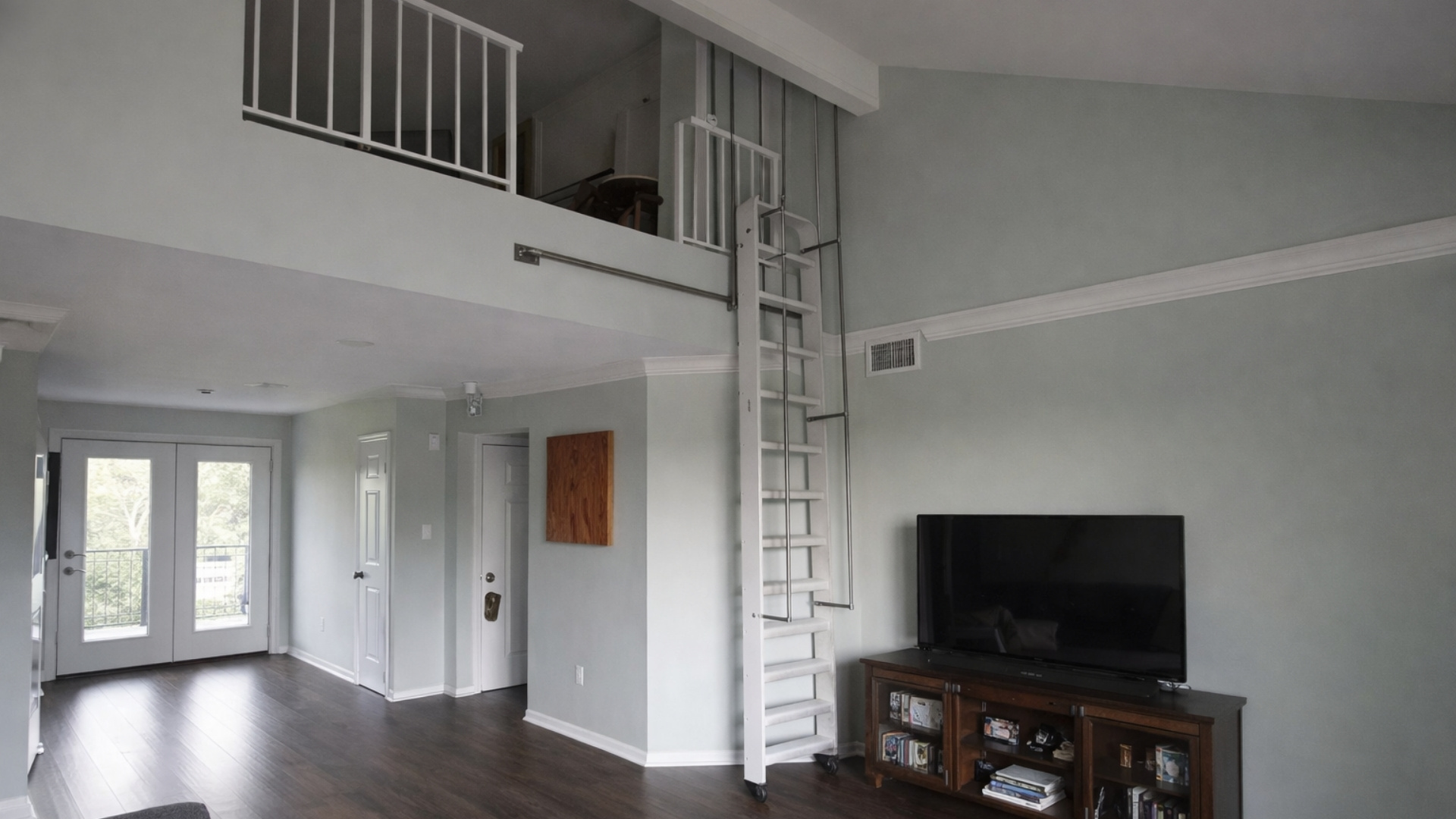
Ship ladders and alternating tread stairs are used when a spiral stair still consumes too much space and is not intended for frequent use.
Compared to spiral stairs, they reduce the footprint further but limit comfort and scope for approval.
How does this compare to a spiral stair?
Requires less floor area than a spiral stair.
Avoids curved fabrication and center-column detailing.
Performs poorly for daily circulation and material movement.
Usually limited to secondary or restricted-use access under U.S. codes.
Best suited where a spiral stair would already be a compromise.
Design considerations
Use limitation: Confirm the stair is permitted for the intended occupancy and access type.
Frequency of use: Not suitable for daily circulation or primary access.
Pitch and comfort: Steep angles reduce user confidence over time.
Handrails and guards: Safety requirements still apply despite the reduced footprint.
Material movement: Plan alternate routes for furniture and equipment.
6. Exterior or Secondary Access Stair Solutions
When the interior floor area cannot accommodate functional alternatives, relocating vertical circulation to the building exterior sometimes provides the space needed for more practical configurations.
Exterior stairs work because they remove vertical circulation from the interior floor area, allow conventional straight or U-shaped geometry, and can be fabricated from corrosion-resistant materials suited to permanent exterior exposure.
Material requirements: Exterior stairs require hot-dip galvanized steel, powder-coated steel with UV-stable finishes, or stainless steel for coastal environments. Tread surfaces must provide drainage and slip resistance in wet conditions.
Now that all the alternatives are listed, let's quickly compare them.
Comparing Spiral Stair Alternatives: Space, Code, and Buildability
Stair Type | Space Efficiency | Code Flexibility | Fabrication Complexity | Long-Term Usability |
Spiral Stair | Smallest (5-6 ft diameter) | Restricted to residential or <250 sf commercial | Moderate, precise radial layout | Poor, narrow treads, no furniture movement |
Curved/Helical | Moderate (6-8 ft radius) | Full IRC/IBC compliance | High, requires steel bending | Excellent, consistent treads, comfortable use |
U-Shaped | Efficient (6x10 ft typical) | Full IRC/IBC compliance | Low, straight flight fabrication | Excellent, full landing, easy furniture movement |
Straight Mono-Stringer | Requires a longer run | Full IRC/IBC compliance | Moderate, engineered center beam | Excellent, consistent treads, modern appearance |
Winder | More compact than U-shaped | Limited to dwelling units (IRC/IBC); curved stairs exception | Moderate, angled treads | Good, better than spirals |
Ship Ladder | Smallest (3x4 ft) | Severely restricted – <200 sf only | Low, steep straight stringer | Poor, steep pitch, occasional use only |
A spiral stair that technically meets code but prevents furniture movement, fails inspection due to fabrication tolerance issues, or reduces property value creates project costs that exceed the value of the floor space it conserves.
The most effective spiral alternatives balance footprint efficiency against code compliance, fabrication predictability, and long-term usability.
Common Mistakes To Avoid When Replacing a Spiral Stair
Replacing a spiral stair is rarely a direct swap. Problems arise when replacements are treated as footprint changes instead of layout, code, and usability decisions.
The issues below most often lead to redesigns, inspection comments, or schedule delays.
Assuming winders meet IBC requirements: Under IBC Section 1011.5.3, winders are generally not allowed in required egress except within individual dwelling units. In most commercial projects, they cannot replace spiral stairs.
Finalizing floor openings too early: Spiral stairs fit within a five-foot diameter. U-shaped or landing-based stairs often need openings closer to 6 by 10 feet. Early cuts can create headroom or layout conflicts.
Using ship ladders outside their intended scope: IRC Section R311.7.12 limits ship ladders to lofts and low-use spaces. Using them in occupied areas often leads to inspection failure.
Ignoring deflection in mono-stringer stairs: Meeting load requirements does not prevent visible movement. Tighter deflection limits help reduce user perception issues.
Overlooking furniture movement: Removing a spiral stair does not guarantee better access. Tight curved stairs can still restrict turning clearance.
Specifying curved stairs without fabrication confirmation: Curved stairs require specialized rolling or bending. Fabrication capability should be verified before committing to the design.
Ignoring thermal movement in exterior stairs: Exterior steel expands and contracts. Connections must allow movement while maintaining load transfer.
Addressing these issues early helps avoid rework, inspection delays, and schedule disruption.
How to Select the Right Spiral Stair Alternative for Your Project?

Selecting a spiral stair alternative works best when decisions are made in the right order. Most redesigns happen when space, use, or fabrication limits are checked too late.
The steps below help narrow viable options early and reduce the need for layout changes.
Step 1: Clarify how the stairs will actually be used
Most stair problems start when use is assumed instead of defined.
Determine whether the stairs support daily circulation or limited access.
Eliminate options that do not align with the intended use.
Treat secondary access stairs differently from primary movement paths.
Step 2: Confirm which regulatory framework applies
Code selection affects which alternatives remain viable.
Confirm whether the project follows residential or commercial standards.
Verify the locally adopted code edition and amendments.
Use this information to screen out non-compliant options early.
Step 3: Validate available space before locking the stair type
Spiral stair replacements often demand more space.
Record accurate floor-to-floor height.
Confirm floor opening size and shape.
Check headroom along the full stair path.
Identify structural or layout constraints that limit options.
Step 4: Match stair geometry to expected daily use
Comfort and durability depend on use patterns.
High-frequency use favors stairs with uniform tread geometry.
Tight radii and steep pitches increase user hesitation over time.
Consider furniture and equipment movement, not just walking clearance.
Step 5: Align the stair type with fabrication capability
Some alternatives increase fabrication risk.
Confirm capability for curved or rolled components where required.
Check tolerance control for stairs with variable geometry.
Account for deflection expectations on exposed structural stairs.
Validate lead times before committing to the layout.
Step 6: Coordinate early to avoid downstream changes
Late alignment creates avoidable rework.
Finalize the geometry before cutting floor openings.
Verify landing elevations against finished floor heights.
Resolve the railing attachment and finish the scope early.
Align fabrication timing with site readiness.
When stair geometry and constraints are nearly finalized, a fabrication check can prevent costly changes later. Reach out to fabricators like Acadia Stairs to review your stair plan before construction begins.
How Acadia Stairs Supports Projects Requiring Spiral Stair Alternatives?
When a project moves away from a spiral stair design, metal fabricators and stair builders need fabrication capacity, engineering coordination, and delivery reliability that support the project's actual schedules.
Acadia Stairs is a custom staircase manufacturing and metal fabrication company based in Fishkill, New York. Working as a direct fabrication partner for metal workers, iron workers, and stair builders, Acadia manages residential and commercial projects where spirals have been eliminated in favor of more functional configurations.
Operating since 2011 with over 40 years of combined team experience, Acadia Stairs specializes in custom metal staircase fabrication for projects throughout the United States.
What Acadia Stairs provides:
Custom fabrication for U-shaped, curved, and straight stair alternatives. Precision-cut steel stringers, welded landing frames, tread support brackets, curved stringer components bent to the specified radius, and connection hardware coordinated with structural framing.
Shop drawing development and pre-fabrication coordination. Detailed shop drawings define stringer geometry, tread layout, landing elevations, weld locations, and connection details before any material is cut or welded.
Integrated railing systems for modern stair configurations. Coordination of railing fabrication with stair component production ensures proper load transfer, code-compliant guard heights, and unified finish specifications.
Material and finish coordination across the project's metalwork. Powder-coated steel in custom colors, hot-dip galvanizing for exterior applications, raw steel with clear coat, and coordinated wood tread finishes.
B2B fabrication support for trade professionals. Fabricated components ship ready for installation, allowing trade partners to integrate Acadia Stairs's work into their project workflows.
Engineering coordination for code compliance. Coordination with project structural engineers ensures fabricated components meet IRC and IBC requirements, including deflection analysis for mono-stringer systems and lateral bracing verification for curved stairs.
Nationwide shipping and delivery coordination. Fabricated stair systems ship throughout the United States, with delivery timing aligned to construction schedules.
By combining engineered fabrication with trade-focused coordination, Acadia Stairs enables stair builders to transition away from spiral designs without compromising schedule, compliance, or build quality.
Conclusion
Spiral stairs save space, but they often create problems during construction and daily use. The right spiral staircase alternative balances footprint, code compliance, and practical movement between floors.
Projects that succeed assess use early, confirm space accurately, and select stair systems that support fabrication, inspection, and long-term usability. When these checks happen upfront, teams avoid redesigns, delays, and costly site fixes.
Acadia Stairs works with metal fabricators and stair builders to deliver custom-fabricated stair alternatives that fit real construction conditions across the U.S.
Review your project with Acadia Stairs before finalizing stair geometry. Contact today!
FAQs
1. How early should a spiral stair alternative be finalized in a project timeline?
Ideally, before framing or floor openings are finalized. Late changes increase coordination effort, inspection risk, and the likelihood of redesign during construction.
2. What information should be prepared before requesting pricing for a spiral stair alternative?
Floor-to-floor height, available opening size, intended use, applicable code, preferred materials, and installation conditions help support accurate scoping and fewer revisions.
3. Do spiral stair alternatives typically affect project schedules?
They can. Alternatives with landings or custom geometry may require longer coordination and fabrication planning compared to standard spiral stair packages.
4. Can spiral stair alternatives be retrofitted into existing buildings?
Yes, but feasibility depends on available space, structural constraints, and access conditions. Early site verification helps determine which alternatives are practical.
5. What documentation helps reduce approval issues for non-spiral stair systems?
Clear shop drawings, verified dimensions, walking-line details where applicable, and alignment with the governing code edition support smoother plan review and inspections.