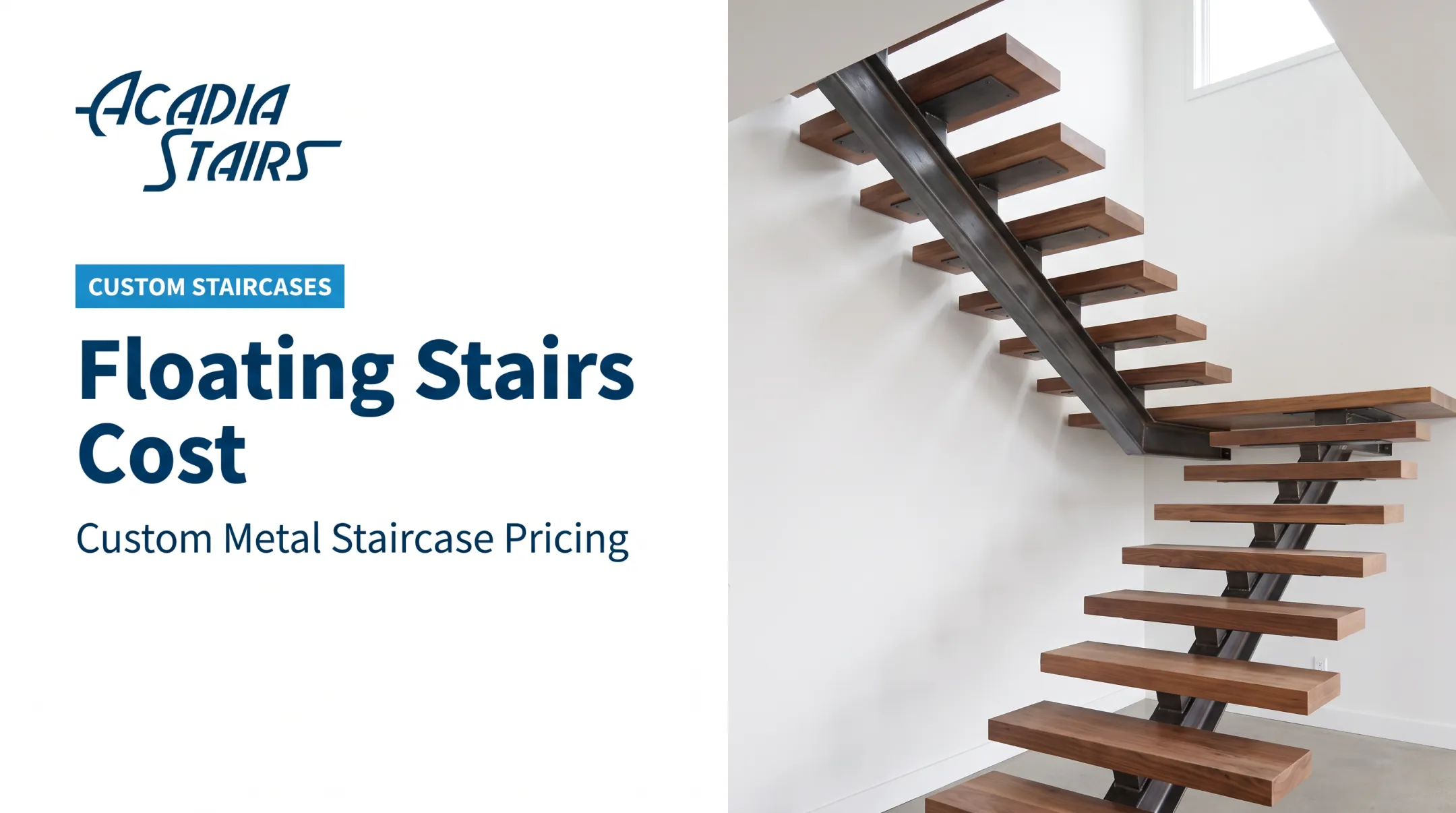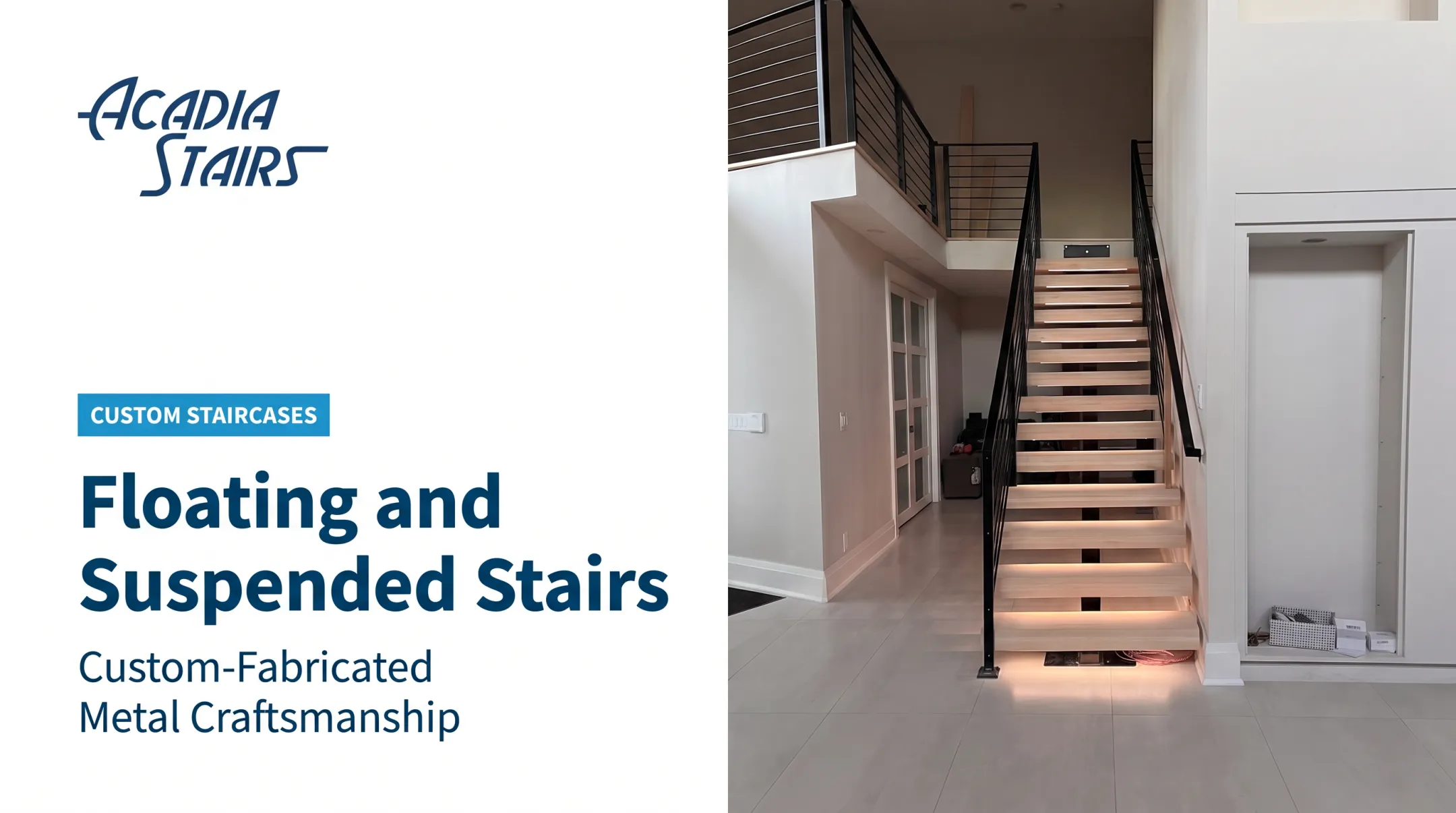
Understanding floating staircase costs requires looking beyond the sticker price. The final number depends on stringer configuration, material choices, railing systems, and whether you're building new or retrofitting an existing space. Many buyers underestimate structural support requirements, treat railings as an afterthought, and overlook permit and engineering fees—mistakes that can derail budgets and timelines. This guide breaks down every pricing layer so you can plan with confidence.
Key Takeaways
- Most residential floating staircases cost $15,000 to $60,000, with the national average falling between $20,000 and $30,000 per flight
- Primary cost drivers include stair shape, stringer type, tread material, and railing system
- Budget builds typically combine mono stringers, red oak treads, and cable railing — premium projects step up to cantilever or concealed stringers, walnut or glass treads, and custom metalwork
- Installation adds 20–30% to material costs; retrofits cost 15–25% more than new construction due to demolition and structural reinforcement
How Much Does a Floating Staircase Cost?
Floating staircases don't have fixed prices. Two projects with identical step counts can differ by tens of thousands based on configuration, materials, and what's included in the quote. A basic straight-run system might start around $15,000 installed, while an architectural centerpiece with curved geometry and glass treads can exceed $100,000.
The most common budgeting mistakes include:
- Structural support runs $1,500–$4,000 more than most quotes show — heavy-duty steel stringers often require reinforced floor joists or beams
- Railing systems account for 20–35% of total project cost; glass panels run roughly triple what cable systems do
- Engineering sign-offs ($500–$1,500) and building permits are required in most jurisdictions but rarely appear in initial estimates
Entry-Level / Basic Floating Staircase
Typical range: $10,000–$20,000
At this tier, you get a functional modern aesthetic using standardized components. Common specs at this price point:
- Straight-run configuration with a standard steel mono stringer (typically 4"×6" rectangular tube)
- Basic hardwood treads — red oak or ash
- Cable railing
- Materials-only packages start around $13,800; installation adds $3,000–$6,000
Best for: Secondary stair runs, straightforward floor-to-floor heights, and homeowners prioritizing function over architectural statement.
Mid-Range / Standard Floating Staircase
Typical range: $20,000–$45,000
This tier represents the most common custom residential project. What you get:
- Premium hardwood treads — white oak or walnut
- Upgraded railing options: rod infill or entry-level glass systems
- L-shaped or switchback configurations with landings
- Each 90-degree turn adds $3,000–$5,000 due to fabrication complexity and landing requirements
Best for: Primary residential staircases where design presence matters but budget has clear limits.
High-End / Custom Floating Staircase
Typical range: $45,000–$100,000+
Premium projects involve complex engineering and fully bespoke fabrication. Features driving costs into this range:
- Cantilever or concealed stringer systems that hide all visible support
- Glass or exotic wood treads
- Curved or helical geometry
- Integrated LED lighting and frameless glass railings
Curved and helical stairs start at $25,000 for the stringer alone, with complete installations frequently exceeding $100,000.
Best for: Luxury residential builds, commercial lobbies, or any project where the staircase defines the architectural character of the space.
Key Factors That Affect the Cost of a Floating Staircase
Pricing is shaped by a combination of structural, material, and design decisions. Changing just one variable—switching from straight to L-shaped, or upgrading from cable to glass railing—can shift the total by thousands.
Stair Shape and Configuration
Shape is one of the biggest cost drivers:
- Straight stairs — Most affordable baseline configuration
- L-shaped stairs — Add approximately $3,000-$5,000 due to landing requirements and custom metalwork at the turn
- U-shaped/switchback stairs — Add approximately $5,000-$8,000 for dual landings and more complex railing geometry
- Curved/helical stairs — Premium tier starting at $25,000-$50,000+ just for the structure, often exceeding $100,000 when finished
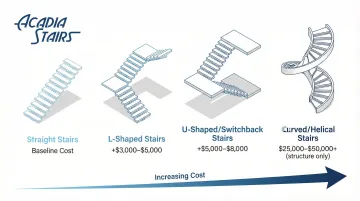
Each change in direction requires custom metalwork, additional tread supports, and more complex railing geometry. Straight runs remain the single most effective way to control costs when budget matters.
Stringer Type and Construction
The stringer is the structural backbone. Costs vary by steel weight, fabrication complexity, and visibility:
- Mono stringer (single central beam) — The most popular modern option. Starts around $5,000 for basic configurations and reaches $30,000 for complex spans. Provides the most open look while maintaining structural integrity.
- Double stringer — Two parallel supports positioned under treads, set in from the edges. Generally comparable to mono stringer pricing, but tends to be more cost-effective for wider stairs while maintaining the floating aesthetic.
- Cantilever (wall-mounted/hidden) — Requires a steel carriage buried in the wall. Despite the minimal visible profile, hidden structure and installation labor push costs to $20,000-$50,000+ due to extensive wall reinforcement requirements.
Material choices also impact price:
- Standard rectangular tubing: $5,000-$12,000
- Laser-cut plate or I-beam: $15,000+
- Stainless steel or aluminum: Premium pricing over standard steel
Tread Material and Thickness
Treads are priced per unit, with thickness impacting both material cost and stringer engineering:
| Material | Price Per Tread | Notes |
|---|---|---|
| Standard wood (red oak, ash) | $40-$300 | 1"-1.5" thick is standard |
| Premium wood (walnut, white oak) | $200-$500+ | Price increases with thickness |
| Metal/steel | $100-$500 | Diamond plate or pans for stone/tile |
| Glass | $1,000-$1,500 | Requires laminated, tempered safety glass |
Thicker butcher-block or glued-up treads (3.5"+) require more material and heavier support structures, adding cost at both the tread and stringer level. Thicker treads also serve a practical purpose: they can satisfy the 4-inch sphere building code rule without needing riser bars.
Railing Design and Material
Railings represent a significant portion of total staircase cost—often 20-35% of the project budget:
Cable railing: Most economical option at $75-$260 per linear foot installed. Provides clean sight lines with minimal maintenance.
Rod/bar infill: Mid-range option at approximately $130-$270 per linear foot, offering traditional aesthetics with modern profiles.
Glass panels: Premium option at $250-$700 per linear foot. A typical 15-step staircase with 20-25 feet of railing translates to $5,000-$14,000+ for glass versus $2,000-$5,000 for cable.
Design complexity adds cost as well. Concealing mounting hardware and achieving a seamless railing look requires more fabrication time and skill. Powder-coated steel railings offer a practical advantage here: the finish maintains color and durability for years without refinishing or touch-ups.
New Construction vs. Remodel
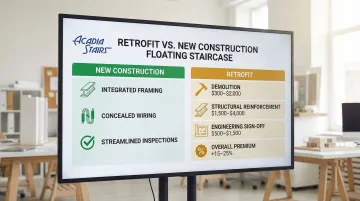
Installing floating stairs in new construction is significantly more cost-effective because support structures can be integrated during framing, wiring for LED lighting can be concealed early, and inspections happen at natural project checkpoints.
Retrofitting floating stairs into an existing home adds costs for:
- Demolition: Removing old staircases costs $300-$2,000
- Structural reinforcement: Installing new beams (LVL or steel) to support point loads costs $1,500-$4,000
- Engineering sign-offs: Structural engineering review adds $500-$1,500 or more
- Overall premium: Retrofits typically cost 15-25% more than new construction due to site constraints and coordination across trades
Full Cost Breakdown: What You're Actually Paying For
Most manufacturer quotes cover materials, fabrication, and sometimes design — but installation, permits, and site prep are typically separate line items. Knowing what each cost category includes helps you build an accurate budget from the start.
Stringer fabrication and materials (30-35% of budget): Covers steel material, cutting, welding, powder coating or finishing. Custom labor is concentrated here — heavy-duty single stringers for curved stairs can weigh 600-900 pounds before treads and railings are added.
Tread materials and finishing (15-20% of budget): Covers lumber or alternate tread material, milling, finishing or staining. Shop-applied finishes typically cost more upfront but deliver better durability than on-site finishing.
Railing system (20-35% of budget): Includes posts, infill (cable, rod, or glass), handrail, and mounting hardware. Glass panels or custom metalwork push this toward the upper end of the range.
Installation labor (20-30% of budget): Typically billed separately from fabrication. Acadia Stairs pre-assembles staircases in-shop, then ships them in modular sections sized for manageable on-site assembly — a process that reduces installation time and keeps labor costs lower than fully field-built alternatives.
Engineering, permits, and shipping (5-10% of budget):
- Structural engineering sign-offs: $500-$1,500
- Local building permits: Varies by jurisdiction
- Freight shipping for prefabricated components: $1,500-$5,000 depending on distance
Acadia Stairs ships to the continental United States and Hawaii — transit runs 3-5 days for the eastern seaboard and up to a week or more for Pacific states. Build that lead time into your project schedule when setting installation dates.
Budget vs. Premium Floating Stairs: What's the Real Difference?
The distinction isn't just about looks—budget and premium options differ in structural precision, material longevity, and long-term performance.
Here's how the two tiers compare on the features that matter most:
| Feature | Budget | Premium |
|---|---|---|
| Stringer type | Standard mono or double | Cantilever or concealed |
| Tread material | Common wood species | Thick hardwood or glass |
| Railing system | Cable railing | Bespoke custom systems |
| Design flexibility | Limited | High |
| Code compliance | Yes | Yes |
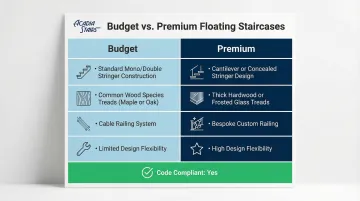
Budget builds cost less upfront, but a premium staircase built with high-grade steel and properly sealed hardwoods typically requires less maintenance over time. Powder-coated steel finishes can last up to 40 years when properly maintained, significantly outlasting standard paint.
Well-fabricated floating stairs with quality steel stringers and finished hardwood treads can last 50+ years with minimal structural maintenance.
Premium staircases also add more to property value, especially when positioned as a focal point. Some estimates put a high-quality floating staircase at roughly 3% of a home's market value—for a $1 million home, a $30,000 staircase essentially pays for itself in added appeal.
How to Plan Your Budget (and Avoid Common Mistakes)
The right budget is determined by intended use, position in the home (primary vs. secondary stair), and design ambition—not by picking the lowest quote. Start with a realistic scope before approaching fabricators.
Common floating staircase budgeting mistakes to avoid:
- Focusing only on stringer or tread price while ignoring railing, shipping, and installation costs
- Choosing a configuration beyond structural requirements (cantilever when a mono stringer would suffice)
- Skipping engineering review to save $500-$1,500, then encountering compliance issues later
- Selecting the cheapest fabricator without evaluating material quality or structural track record
Smart budgeting strategies:
- Request itemized quotes that separate fabrication, materials, railing, delivery, and installation
- Compare quotes on a like-for-like basis — a $25,000 quote covering glass railing and installation may be a better value than a $20,000 quote for materials only with cable railing
- Prioritize fabricators who can walk you through what's included, not just the bottom line
Working with a single-source manufacturer — one who handles design, fabrication, and shipping — reduces coordination overhead and typically produces more accurate upfront pricing. Acadia Stairs, with over 40 years of combined experience, ships custom staircases across the continental United States and works with each client to fit space, safety requirements, style, and budget.
Don't overlook ongoing maintenance costs when setting your budget. Metal stairs with quality powder coating need only occasional cleaning; wood treads may need refinishing every 10-15 years; glass railing panels require regular cleaning to stay clear. These recurring costs are modest but worth factoring in from the start.
Frequently Asked Questions
Are floating staircases more expensive?
Yes, floating stairs typically cost 30-50% more than traditional closed-riser staircases because of the hidden structural engineering, precision fabrication, and custom metalwork required to achieve the floating appearance safely and to code. Traditional stairs rely on simple framing hidden by drywall; floating stairs are the structure.
How long do floating stairs last?
Well-fabricated floating stairs built with quality steel stringers and properly finished hardwood or metal treads can last 50+ years with minimal structural maintenance. Surface materials like wood finishes or powder coating may need refreshing over time, but the structural integrity remains sound for decades.
Do floating stairs meet code?
Yes, floating stairs meet building codes when properly engineered and installed. They must comply with requirements for tread depth, riser height, handrail graspability, load capacity, and the 4-inch sphere rule for open risers — which is why structural engineering review and local permits are required steps.
What is the cheapest type of floating staircase?
A straight-run mono stringer staircase with standard hardwood treads (such as red oak) and cable railing is typically the most affordable floating stair configuration, representing the lower end of the typical price range at $10,000-$20,000 installed.
How much does it cost to install floating stairs?
Installation is typically quoted separately from fabrication, ranging from $3,000 to $10,000+ depending on complexity. New construction installations are simpler and less expensive, while retrofits requiring demolition and structural reinforcement can add 15-25% to labor costs. Stairs designed for easy assembly can significantly reduce installation time and expense.
Do floating stairs add value to your home?
Floating stairs often become a signature design feature that increases perceived luxury and market appeal. A general industry guideline positions staircase cost at roughly 3% of a home's market value — so a $30,000 staircase fits a $1 million home and contributes proportionally to resale value.