Modern floating stairs are one of the most requested features in contemporary homes, and one of the easiest ways to create costly problems if they’re treated like a standard stair. What looks like a simple, “floating” design depends on load paths, wall structure, fabrication tolerances, and code details that are locked in long before the first tread is installed.
Many floating stair projects don’t fail because of poor craftsmanship. They fail because critical decisions about support, materials, and coordination are made too late. By the time issues show up, during installation or inspection, options are limited, and rework is expensive.
This guide breaks down how modern floating stairs are actually built, what separates reliable systems from risky ones, which materials and support strategies perform best under real loads, and what U.S. inspectors expect to see.
Key Takeaways
Modern floating stairs are engineered structural systems where early decisions on support type, wall capacity, and load paths determine inspection success and project cost.
Mono-stringer and wall-mounted cantilever stairs differ significantly in coordination risk, fabrication tolerance, and installation complexity.
Steel-based and hybrid stair systems offer better dimensional control and vibration performance than finish-driven wood systems when properly detailed.
Floating stairs must meet strict U.S. code requirements for tread loads, riser spacing, headroom, guards, and railings, with minimal allowance for field fixes.
Most schedule delays and cost overruns result from late coordination between structure, fabrication, finishes, and railings rather than the stair design itself.
What Are Modern Floating Stairs?
Modern floating stairs are stair systems designed to create visual openness by minimizing visible structural elements while still relying on engineered support. The “floating” effect is achieved by concealing structural components within walls, central stringers, or integrated framing rather than removing structure altogether.
Unlike conventional staircases, modern floating stairs are planned as coordinated assemblies. Their layout influences wall construction, floor openings, railing attachment, and installation sequencing, making early design and fabrication coordination essential.
These stair systems are commonly specified for residential and commercial projects that require clean geometry, open sightlines, and predictable execution. While visually light, modern floating stairs serve as permanent structural elements and must be designed, fabricated, and installed with high accuracy.
Types of Materials Used in Modern Floating Staircases
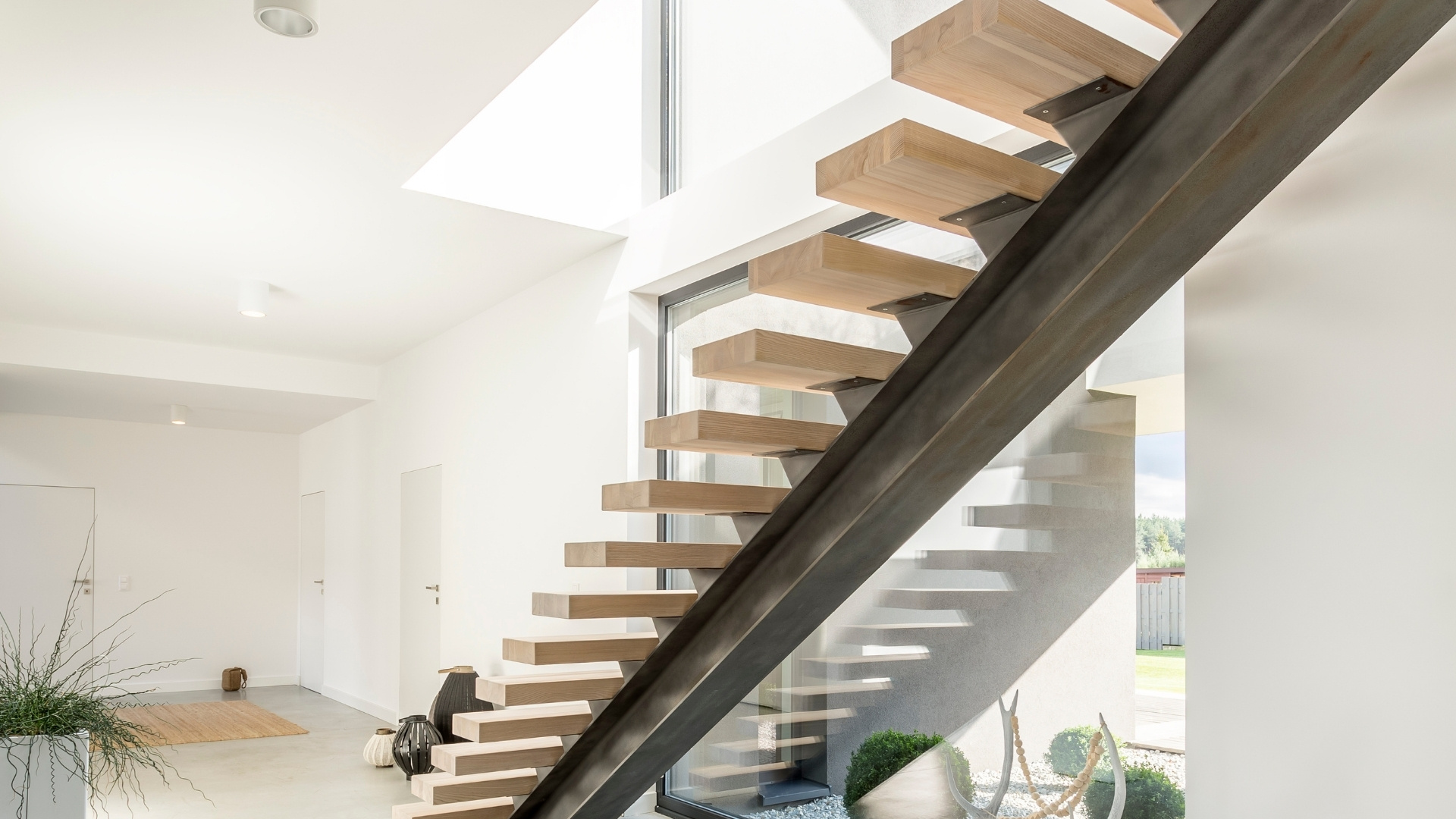
Material selection in modern floating staircases influences fabrication accuracy, coordination effort, and installation predictability. For metal workers and stair builders, materials are evaluated based on how reliably the stair can be built, supported, and finished.
Steel-Based Floating Stair Structures
Steel is commonly used as the primary structural material in floating stair systems because it supports controlled geometry and predictable fabrication.
From a fabrication standpoint:
Steel enables concealed structural support.
It allows accurate shop drawings and repeatable production.
It integrates efficiently with railing attachments and connection details.
Steel systems are often selected when open risers, minimal profiles, or tight tolerances are required.
Floating Wood Stairs and Finish-Driven Systems
Floating wood stairs typically use wood as a visible finish while relying on concealed structural support.
Key coordination considerations include:
Structural support and finish elements are handled separately.
Wood movement and long-term wear must be accounted for early.
Attachment detailing influences vibration and perceived stability.
Clear separation between structure and finish helps reduce post-installation issues.
Hybrid Floating Stair Systems
Hybrid systems combine a metal structural framework with wood or composite treads.
These systems are often chosen because they:
Balance structural reliability with design flexibility.
Improve dimensional control compared to full wood stairs.
Support predictable fabrication and installation sequencing.
Hybrid construction is common in custom residential and commercial projects where both performance and appearance matter.
Steps to Build Modern Floating Stairs
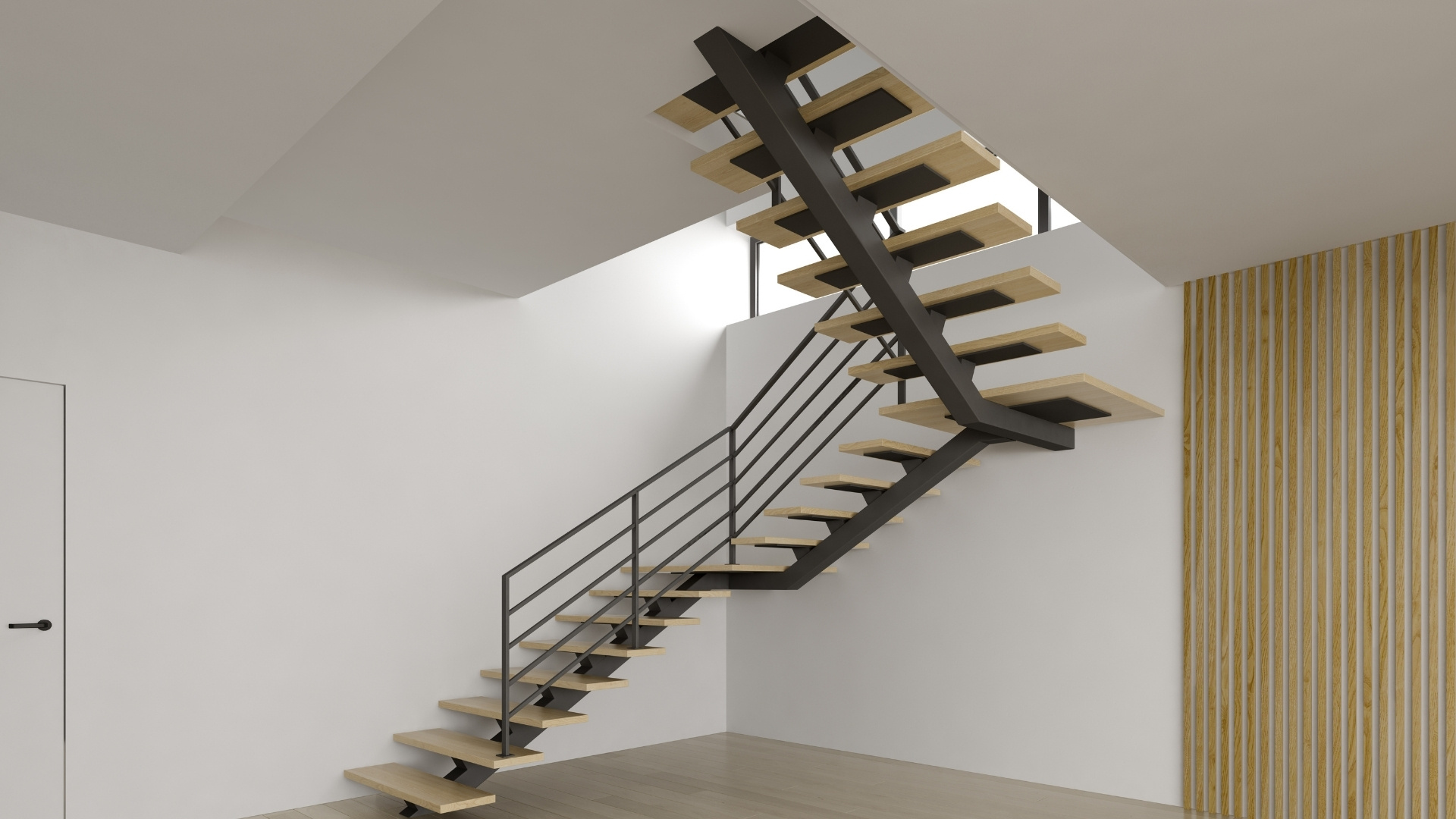
Modern floating stairs are not assembled on site by feel. They are built through a defined sequence where structure, fabrication, and installation must align. Skipping or reordering steps is where most floating stair failures occur.
Below is the typical build process used in professional floating stair projects.
Step 1: Confirm the Structural Support Strategy
Before any stair is designed or priced, the support method must be confirmed. Floating stairs rely on one of two systems:
Wall-mounted cantilever system (treads supported by the wall).
Mono-stringer system (treads supported by a center steel spine).
This decision determines:
Whether a load-bearing wall is required
How loads are transferred into the building
What level of fabrication precision is needed
If wall capacity cannot be verified early, a mono-stringer system is typically the safer option.
Step 2: Verify Load Paths and Engineering Requirements
Floating stairs concentrate loads at fewer points than traditional stairs. Each tread and connection must be engineered accordingly.
Key structural requirements include:
Minimum 300 lbs live load per tread (code requirement).
Combined dead load of tread material and finishes.
Cantilever depth or bracket span.
Stringer stiffness to control deflection and vibration.
A structural engineer should review these parameters before shop drawings are finalized.
Step 3: Fabricate the Primary Structural Components
Once engineering is approved, the primary steel components are fabricated.
For wall-mounted cantilever systems
Steel brackets are cut and welded from structural plate.
Brackets are sized per tread load and cantilever depth.
Anchor or embedment details are built into the bracket design.
For mono-stringer systems
The center stringer is fabricated from a rectangular tube, an I-beam, or a custom section.
Tread brackets are welded or bolted at calculated spacing.
Stringer geometry is controlled tightly to maintain level treads.
At this stage, tolerances are critical. Small errors compound once the finishes are added.
Step 4: Coordinate Building Structure and Framing
Before the stair arrives on site, the surrounding structure must be ready to receive it.
This includes:
Reinforcing walls for cantilever brackets.
Verifying slab, beam, or joist capacity at the landing.
Confirming finished floor heights and ceiling clearances.
Locking in floor-to-floor dimensions.
Most floating stair delays occur here when framing assumptions do not align with site conditions.
Step 5: Install the Structural Stair System
The structural stair is installed before the finishes.
Installation sequence
Set and anchor cantilever brackets or mono-stringer.
Secure top and bottom connections to the building structure.
Verify level, plumb, and alignment.
Confirm deflection is within acceptable limits.
At this stage, the stair may look unfinished, but all structural performance is established.
Step 6: Install Treads and Finish Components
Once the structure is fixed, finish elements are added.
This typically includes:
Wood, steel, stone, or glass treads.
Riser infill (if applicable).
Concealment of brackets or fasteners.
Surface treatments for slip resistance.
Separating structure from finishes reduces rework if materials change.
Step 7: Install Railings and Guards
Railings introduce additional loads and must be treated as structural elements.
Key checks:
Guard height meets code (typically 42 inches for open sides).
Openings do not exceed the 4-inch sphere rule.
Handrails are continuous where required.
Railing loads transfer into the stair structure, not finishes.
Poor coordination of railings is a common reason for failed inspections.
Step 8: Final Inspection and Load Verification
Before sign-off:
Verify tread uniformity and spacing.
Check headroom clearance (minimum 80 inches).
Confirm railing and guard compliance.
Inspect connections at landings and walls.
When built correctly, floating stairs pass inspection without special exemptions.
Contemporary Floating Stair Styles and Ideas

Contemporary floating stairs are often grouped together visually, but from a construction standpoint, they behave very differently. The support method, tread material, and railing integration determine how much coordination is required, how predictable fabrication will be, and how much risk is carried into installation.
Below are the most commonly used floating stair configurations:
Mono-Stringer Floating Stairs
Mono-stringer systems use a single steel beam running along the center of the stair, with treads mounted to welded or bolted brackets. This is the most commonly specified floating stair system in both residential and light commercial work.
The main advantage of a mono-stringer is structural independence. Because the stair does not rely on a load-bearing wall, it can be installed in open-plan spaces without major wall reinforcement.
Mono-stringers offer:
Predictable load paths.
Repeatable geometry.
Easier tolerance control.
Compatibility with wood, steel, stone, and glass treads.
This system is often paired with wood treads and glass or cable railings, but the underlying structure remains consistent across many finish variations.
Wall-Mounted Cantilever Floating Stairs
Cantilever floating stairs achieve the strongest visual “floating” effect by supporting each tread from the wall without visible stringers. Structurally, this is also the most demanding configuration.
Each tread is supported by a concealed steel bracket embedded into a load-bearing wall. This requires:
Concrete or steel-reinforced wall construction.
Early confirmation of wall capacity by a structural engineer.
Precise coordination between wall framing, finishes, and stair fabrication.
Cantilever systems leave little room for field adjustments. If wall conditions change after fabrication, rework is often unavoidable. For this reason, cantilever stairs perform best in projects where structural design is locked early, and sequencing between trades is tightly controlled.
Hybrid Floating Stair Systems
Hybrid floating stairs combine a steel structural system with wood, composite, or stone finish treads. The structure and the visible finish are treated as separate components.
This approach is commonly used to:
Improve dimensional control.
Reduce vibration and deflection.
Allow finishing installation later in the schedule.
Steel handles the structural performance, while finish trades install tread caps or assemblies after the stair is set. This separation reduces callbacks related to wood movement and allows greater flexibility if finishes change late in the project.
LED-Integrated Floating Stairs
LED lighting is now frequently incorporated into contemporary floating stairs, particularly in residential, hospitality, and showroom projects.
From a construction standpoint, LED integration affects:
Stringer or bracket detailing.
Wire routing and concealment.
Power supply and driver access.
Lighting must be planned during design and fabrication. Adding an LED after installation often requires surface-mounted components or disassembly, increasing cost and complexity. When coordinated early, LED systems integrate cleanly without affecting structural performance.
Zigzag and Sculptural Stringer Designs
Zigzag or folded steel stringers replace straight center spines with angular profiles that follow the stair geometry. These designs are used when the stairs themselves are intended to be a visual feature.
While structurally sound, these systems:
Require more fabrication time.
Increase welding and finishing scope.
Demand tighter tolerance control.
They are best treated as custom architectural elements rather than standard stair systems and should be priced accordingly.
Are Modern Floating Stairs Safe?
This is the most common question from homeowners and contractors alike. The short answer: yes, when they are designed and built to code.
Floating stairs are not inherently less safe than traditional staircases. What changes is the load's concentration. A conventional stair has multiple redundant supports. A floating stair puts load into fewer points, which means each point must be engineered more carefully.
Here is what makes a floating stair safe in practice:
Each tread is engineered to support at least 300 lbs. This is a code requirement, not optional.
The support structure is sized by a structural engineer based on actual spans and loads.
Railings meet guard height and load requirements per applicable code.
Anti-slip treatment on treads is standard for wood and stone surfaces.
Open riser gaps are kept to less than 4 inches to prevent foot slippage.
If any of these points are skipped or approximated, that is where risk enters. It does not come from the floating design itself.
Building Codes for Modern Floating Stairs in the U.S.
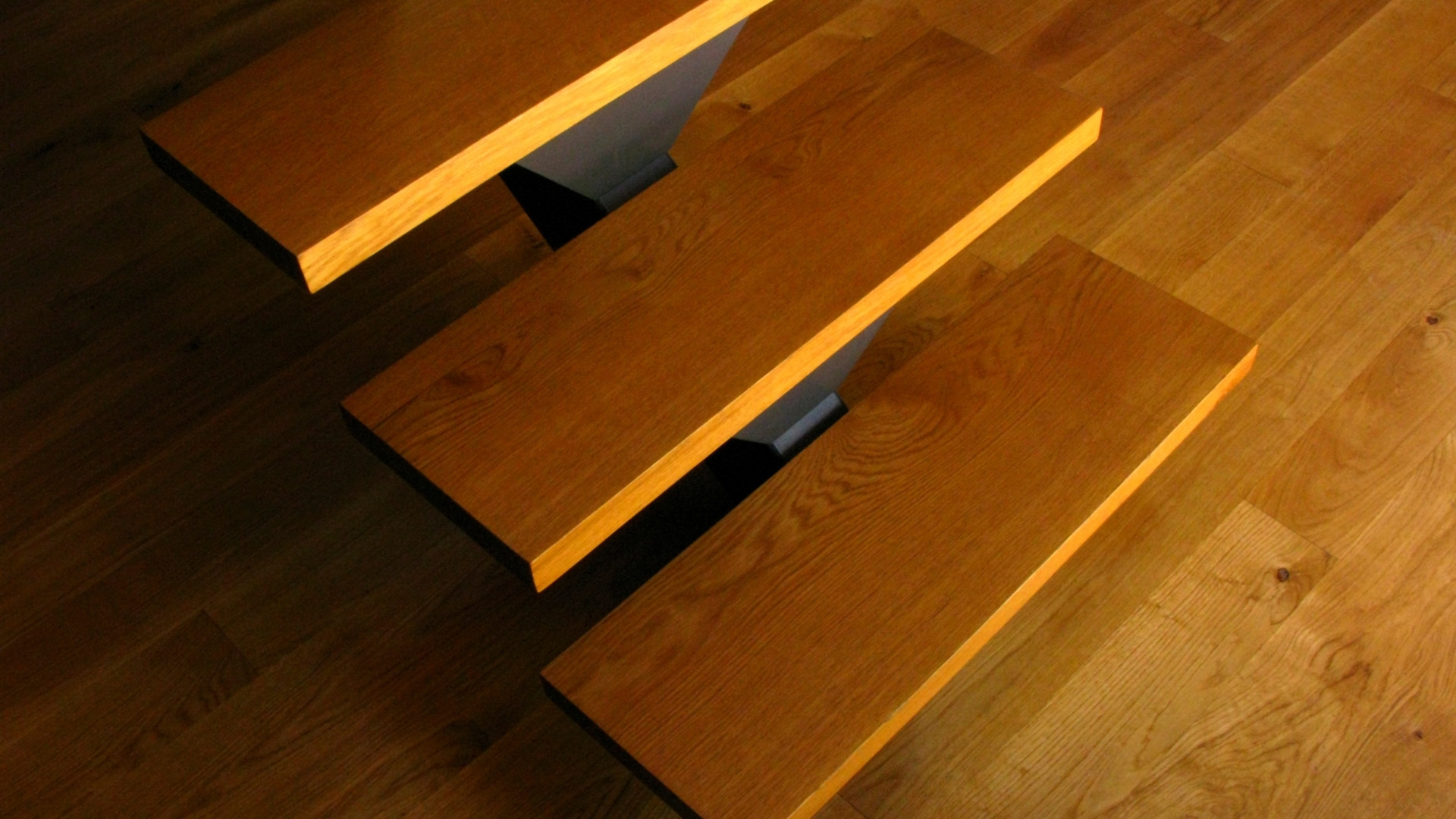
U.S. building codes for floating stairs fall under either the International Residential Code (IRC) or the International Building Code (IBC), depending on building type. IRC covers single-family and two-family homes up to three stories. IBC covers commercial and multi-family structures.
Most jurisdictions adopt one as their base code, then add local amendments. Confirm the applicable edition and local modifications before finalizing a design.
Key Requirements That Apply to Floating Stairs
Stair width: Minimum 36 inches clear width for residential under IRC. Commercial stairs under the IBC must have a minimum of 44 inches between handrails.
Riser and tread dimensions: Under IBC, riser height must be between 4 and 7 inches. Tread depth must be at least 11 inches. All risers and treads in a flight must be uniform. Variation cannot exceed 3/8 inch.
Headroom: A minimum of 80 inches of vertical clearance from the tread nosing to the ceiling, maintained along the full run.
Open riser rule: The gap between treads must not allow a 4-inch diameter sphere to pass through.
Handrails: Required on at least one side for flights with four or more risers under IRC. IBC requires both sides for commercial stairways. Handrails must run continuously from top to bottom.
Guards: Open sides must have guards at least 42 inches high, per the IBC. Spacing must be less than 4 inches.
Landings: Required at the top and bottom of each flight. Landing depth must be at least 36 inches in the direction of travel.
Note: Local jurisdictions may add requirements beyond IRC or IBC. Check with your local building department before finalizing any design.
When Floating Stairs Are the Right Design Solution?
Not every project needs a floating stair. But when the conditions are right, they solve problems that other stair types cannot.
Floating stairs work best when:
The space is open-plan. They allow light to move through without blocking sightlines.
The structure supports the load. A load-bearing wall or properly engineered floor framing is available.
The project prioritizes visual openness. This applies to lobbies, showrooms, or modern homes where the stairs are a focal point.
Fabrication precision is manageable. Floating stairs need tighter tolerances than traditional builds.
They are not the right fit when:
The adjacent wall is not load-bearing and cannot be reinforced.
The budget is tight, and a simpler stair type meets the functional need.
Structural uncertainty has not been resolved by engineering
If you are comparing a floating stair to straight stairs or curved stairs, the deciding factor is whether the structure and space support the open design.
Common Floating Stair Design Challenges and How to Solve Them
Most problems with floating stairs come from gaps in planning or coordination between trades, not from the fabrication itself. Let’s look at the most common issues and how to avoid them.
The Wall Cannot Handle the Load.
The problem: A cantilever design is specified, but the wall is a non-load-bearing partition.
What you can do: Confirm wall structure with a structural engineer before design work begins. If the wall cannot be reinforced, switch to a mono-stringer system early.
Headroom Is Too Low at the Top of the run.
The problem: The ceiling above does not provide enough vertical clearance above the upper treads.
How to avoid it: Measure floor-to-floor height and ceiling finish buildup before laying out the stairs. Work backward from the 80-inch headroom rule to determine maximum riser count.
Tread Deflection Under Load
The problem: Wood or thin metal treads flex noticeably when walked on, especially on wider stairs.
In order to avoid it, size the tread thickness based on span width. For wood on a mono-stringer, 3 to 4 inches is a common starting point. Thinner treads need additional brackets beneath them.
Railing Does Not Meet Code
The problem: Guard height is under 42 inches, spacing allows a 4-inch sphere through, or handrails are not continuous.
How to avoid it: Design the railing at the same time as the stair structure. Custom railings should be specified to match the stair geometry from the start.
Build Custom Modern Floating Stairs with Acadia Stairs
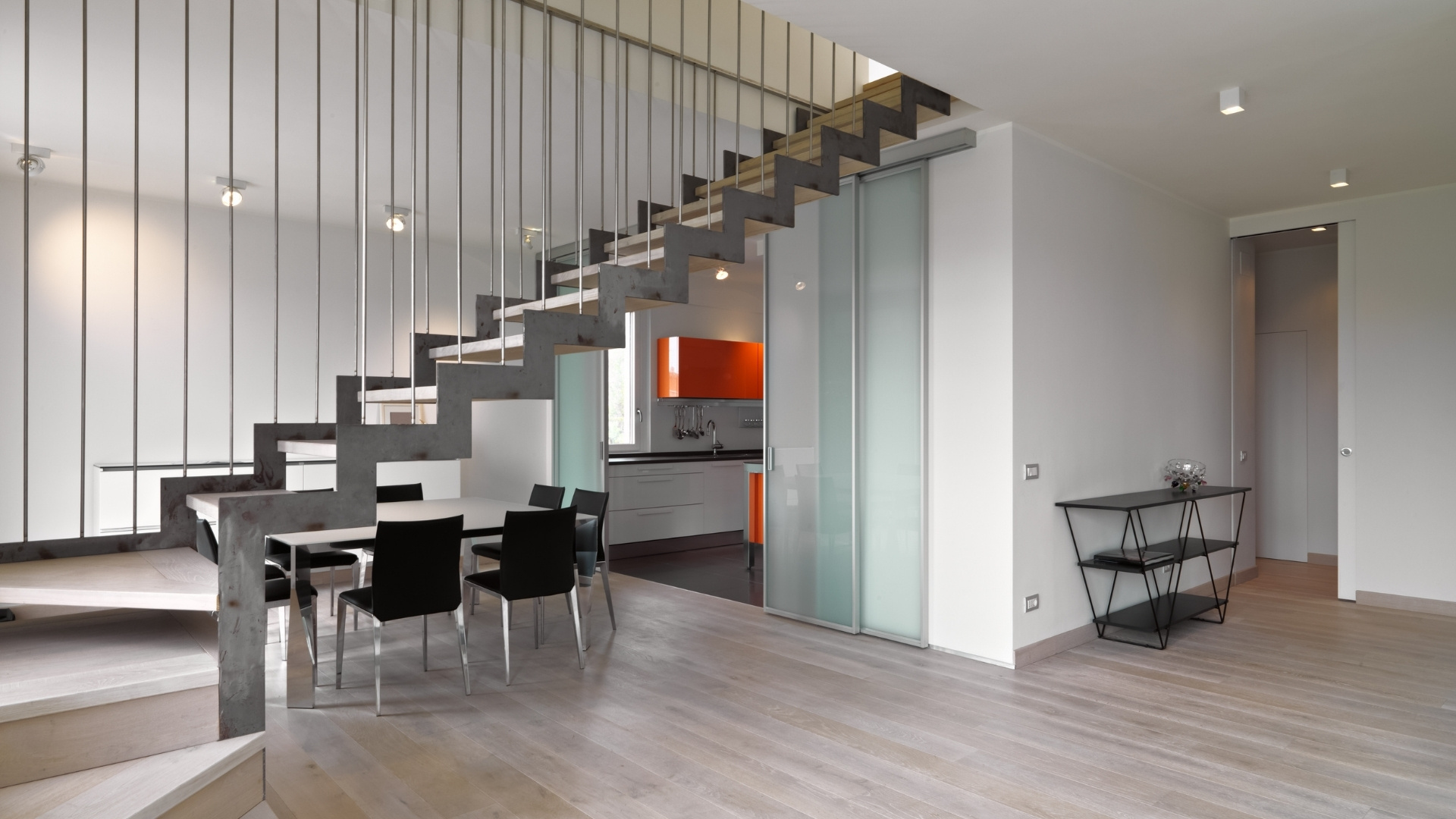
Acadia Stairs is a custom staircase manufacturing and metal fabrication company based in Fishkill, New York. Founded in 2011 with over 40 years of combined experience among its team, they work with homeowners, contractors, metal fabricators, and architects across the United States.
For floating stair projects, Acadia's single stringer staircases are built around a heavy-duty center beam that supports up to 300 lbs per tread. The stringer is fabricated from structural steel in rectangular tube, square tube, round tube, I-beam, and tri-frame configurations.
Here is what Acadia brings to a floating stair build:
Custom steel stringer fabrication: Sized to approved shop drawings with tight tolerances for accurate installation.
A full range of tread options: Wood (oak, walnut, maple), steel, laminated glass, and stone are all available.
LED stair integration: Dimmable, color-tunable LED systems with included wiring and wireless controller.
Custom railing systems: Wrought iron, steel, and glass options designed to meet code requirements.
Powder coating: Long-term finish protection on all steel components.
Nationwide shipping: Fabricated components are delivered directly to the job site.
Additionally, Acadia Stairs offers free design consultations. Share your project details, including floor-to-floor height, layout, and finish preferences, and their team will walk you through the options.
Conclusion
Modern floating stairs work best when they are treated as part of the building structure, not as a late-stage design feature. Once the support method is chosen, everything else follows from that decision. Tread thickness, railing attachment, wall conditions, and inspection outcomes. These are not independent choices.
When starting the project, you should involve a stair fabricator who works at the same level of detail as you do. Acadia Stairs works with stair builders, metal fabricators, and contractors to develop floating stair systems that are detailed for real structural conditions and fabrication constraints, not just visual intent.
If you are scoping a floating stair and want to confirm the right support system, materials, and detailing before fabrication begins, connect with Acadia Stairs and review your project requirements with their team.
FAQs
1. Do modern floating stairs require shop drawings before structural framing is complete?
Yes. Shop drawings are needed early to coordinate wall reinforcement, landing connections, floor heights, railing loads, and tolerances before framing and steel fabrication begin.
2. Can modern floating stairs be prefabricated off-site?
Yes. Structural components are typically fabricated off-site for accuracy, then installed on-site once wall conditions, floor elevations, and structural supports are verified.
3. What causes cost overruns in modern floating stair projects?
Cost overruns usually result from late design changes, unverified wall capacity, incorrect floor heights, railing redesigns, and rework caused by poor trade coordination.
4. Are modern floating stairs suitable for commercial buildings?
Yes, when designed under IBC requirements with proper stair width, guard heights, handrails, and engineered load paths approved by a structural engineer.
5. How early should a stair fabricator be involved in a floating stair project?
A stair fabricator should be involved during schematic design to confirm support strategy, tolerances, material behavior, and coordination requirements before engineering and pricing are finalized.