Here's the reality: staircase pricing varies enormously. A basic straight run in standard softwood might cost a few thousand dollars, while a custom curved installation with glass panels and architectural steel can easily push past six figures. The gap between those numbers isn't arbitrary—it's explained by a handful of specific, knowable factors that you can control at the planning stage.
Key Takeaways
- New staircases range from $3,000 for basic straight runs to $100,000+ for custom high-end builds
- Shape, materials, and customization level drive the biggest price differences
- Budget builds are functional; high-end staircases are design centerpieces — and the cost breakdown reflects that difference
- Quality materials and quality construction reduce long-term maintenance costs and boost resale value
- Installation labor typically equals 30-50% of your total cost—not just the staircase itself
How Much Does a Staircase Actually Cost?
There is no single "staircase price." Costs vary based on shape, materials, size, your local labor market, and whether you're buying prefab or going fully custom. Misunderstanding this leads homeowners to either underbudget badly or overbuild unnecessarily.
The two most common budgeting mistakes: anchoring to a low estimate seen online (which usually reflects basic prefab wood stairs only), and failing to account for installation, finishing, and permit costs.
That $4,000 quote you found? It probably doesn't include the $2,500 in labor, the $800 permit fee, or the $600 in wall repairs.
Here's how costs actually break down across three tiers.
Entry-Level Staircases
Entry-level staircases typically cost $3,000–$7,000 for materials and installation. This tier covers a straight staircase in standard dimensions, using common materials like pine or basic oak, with simple closed risers and a standard wood or basic metal railing.
This works best for budget-conscious homeowners doing a straightforward replacement in a secondary space, rental properties where function matters more than aesthetics, and basic new builds where the staircase is utilitarian rather than a design feature.
Mid-Range Staircases
Mid-range staircases run $8,000–$25,000 and represent the most common tier for main-level renovations. These include L-shaped or U-shaped configurations, better wood species (red oak, maple, walnut), or wood-and-metal combinations with open balusters, upgraded railings, and some customization.
Best-fit buyers:
- Homeowners who want their staircase to be a noticeable design element
- Contractors building spec homes where aesthetics impact sale price
- Projects where the staircase connects high-visibility living spaces
High-End and Custom Staircases
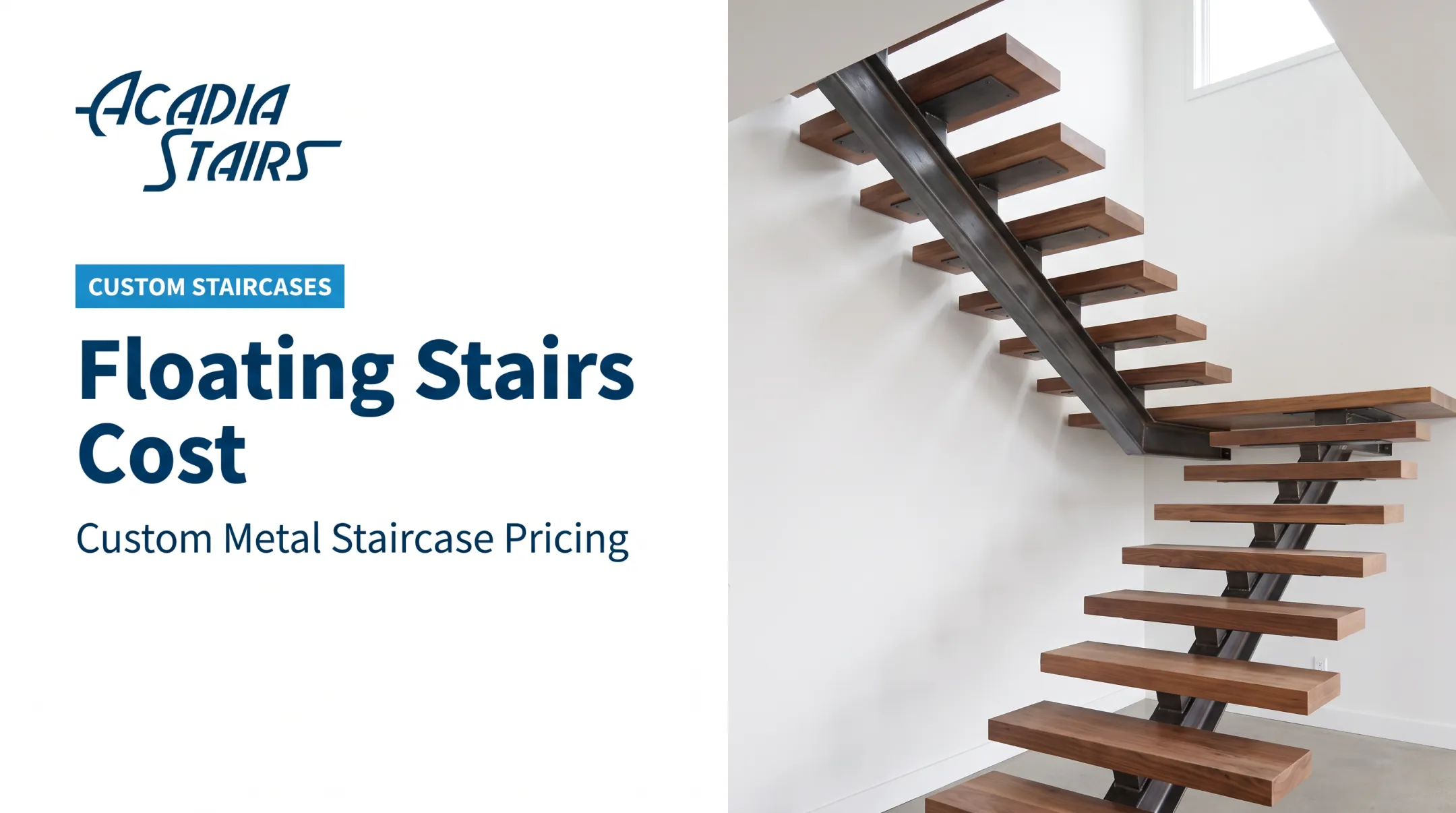
Premium staircases range from $25,000 to $100,000+. This tier includes curved staircases, fully custom metal or steel builds, glass panel railings, architectural floating stairs, or any combination of exotic materials.
Who invests here:
- Homeowners treating the staircase as a design centerpiece
- Architects and interior designers working on high-specification projects
- Commercial spaces where visual impact is part of the brand
- Projects requiring specialized engineering for unique geometries
Acadia Stairs works exclusively in this space — custom-fabricated metal staircases built to exact client specifications, with over 40 years of combined design experience. Their process starts with aligning design to budget before fabrication begins, so there are no costly surprises mid-project.
Key Factors That Drive Staircase Cost
The final number on any staircase quote comes from several compounding variables. Knowing what drives each cost helps you make smarter trade-offs instead of cutting in the wrong places.
Shape and Configuration
Shape is one of the earliest and highest-impact decisions. Each configuration adds cost in a different way:
- Straight stairs: Most labor-efficient; no intermediate support structuring required
- L-shaped and U-shaped: More material at the landing, more complex railing work
- Winder configurations: Custom tread fabrication adds cost per step
- Curved or spiral staircases: Require specialized engineering, tooling, and installation skill
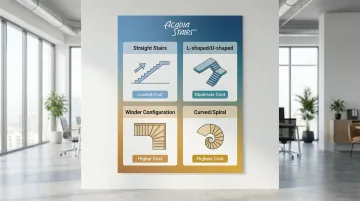
That complexity has real weight behind it — a curved single-stringer staircase can use 600–900 pounds of structural steel before treads and handrails are factored in, demanding precision fabrication that straight stairs simply don't.
Materials
Material costs vary dramatically:
- Pine/Softwood: $30–$50 per step (material only). Budget option, prone to denting, best for carpeted stairs
- Red Oak/Maple: $100–$220 per step. Industry standard for durability and value
- White Oak/Walnut: $180–$300 per step. Premium hardwoods with superior wear resistance
- Glass: $250–$550 per step. Requires tempered/laminated safety glass
- Stone/Concrete: $100–$900 per step depending on whether it's precast or custom
For railings:
- Steel/Wrought Iron Balusters: $3–$17 per piece (uninstalled); full systems run $1,600–$3,400 installed
- Glass Panel Railings: $250–$700 per linear foot installed
- Stainless Steel: $40–$80 per linear foot for materials
Customization vs. Prefab
Prefabricated staircase kits offer fixed dimensions and limited material choices with lower upfront costs, but often require modifications that add labor. Fully custom-built staircases are designed to exact specifications — costing more upfront, but delivering better fit, finish, and long-term durability.
Acadia Stairs works across both ends of this range, with a collaborative design process (3D renderings, shop drawings, revision rounds) that helps prevent expensive change orders after fabrication starts.
Number of Steps and Overall Rise
Total rise (floor-to-floor height) and number of treads directly scale material and labor costs. A 10-step staircase costs less than a 16-step one in the same style. Multi-story or mezzanine applications push costs higher still, often requiring intermediate landings that add both material and structural complexity.
Labor and Regional Cost Variation
Installation labor represents 30–50% of the total project cost. Costs vary by region: urban Northeast and West Coast markets run roughly 20% above national averages, while Southeast and rural areas come in about 10% lower.
Labor rates:
- Basic installation: $500–$4,500 for standard straight staircases (8-16 hours)
- Custom/complex installation: $60–$140 per hour for specialists, with complex jobs taking 4+ days
- General contractors: $50–$150 per hour
- Master carpenters: $100–$200 per hour for high-end finish work
Structural modifications, wall removal, or floor-level changes at the stair base add contractor costs beyond the staircase itself.
What Goes Into the Final Price Tag: Full Cost Breakdown
The staircase itself—the materials and fabrication—is only one part of what you'll actually pay. A realistic budget needs to account for four distinct cost categories.
Materials and Fabrication
This is the largest variable cost, covering raw materials (treads, risers, stringers, railings, balusters, newel posts) plus any manufacturing or fabrication work. Custom metalwork, curved stringer fabrication, and specialty finishes like powder coating all fall here.
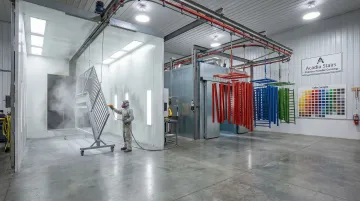
Powder coating adds upfront cost but significantly extends component lifespan by protecting metal against corrosion, scratches, and wear. Acadia Stairs runs an in-house powder coating facility, which gives buyers direct control over color and finish selection without third-party markups. Their coating applies at twice the thickness of traditional paint, which translates to fewer touch-ups and lower long-term maintenance costs.
Installation and Labor
Installation costs include:
- Demolition of the old staircase (if replacing)
- Site preparation and structural framing adjustments
- Actual installation of all components
- Finishing work (sanding, staining, painting, sealing)
Basic straight staircase installation typically requires 1-3 days, while complex custom or curved installations can take 1-3 weeks depending on fabrication lead time and site conditions. Note that this doesn't include the 2-4 week lead time for fabricating custom steel or glass components off-site.
Permits and Inspections
Most jurisdictions require a permit for new staircase construction or significant structural remodeling because staircases are a primary means of egress and a structural component. Permit fees typically range from $100 to $1,200 depending on project valuation and local municipality. Failure to pull permits can create issues at resale and may result in mandatory retrofits.
Ongoing Maintenance Costs
Different materials dictate different long-term ownership costs:
| Material | Maintenance Frequency | Estimated Cost | Notes |
|---|---|---|---|
| Hardwood Treads | Refinish every 7-10 years | $300–$1,200 | Full sanding and refinishing required |
| Powder-Coated Steel | Touch-up every 5-7 years | $100–$250 | Minimal maintenance; decorative warranties last 15-20 years |
| Glass Panels | Clean quarterly; seal every 15-20 years | $150–$300 | Seals and gaskets may degrade over time |
Over a 20-year ownership window, the maintenance cost gap between materials can rival the original installation price difference—making material choice a long-term financial decision, not just an aesthetic one.
Budget Staircase vs. Premium Staircase: What's the Actual Difference?
The right choice between budget and premium isn't obvious. It comes down to how the staircase is used, how long you plan to own the property, and what role it plays in the space.
- Durability: Softwood like pine dents and splinters within 10-15 years of normal use. Quality hardwoods (white oak, walnut) and powder-coated metals routinely last 30-50+ years and can be sanded and refinished multiple times.
- Aesthetics: Prefab staircases show visible seams and offer limited customization. Custom builds match the space precisely — the difference is immediately visible to anyone who walks through the door.
- Resale value: Homeowners typically recoup 60-80% of their investment on a hardwood stair upgrade. In competitive markets, a statement staircase can accelerate a sale.
- Installation: Budget staircases install in 1-3 days. Custom builds often require phased installation and coordination across multiple trades.
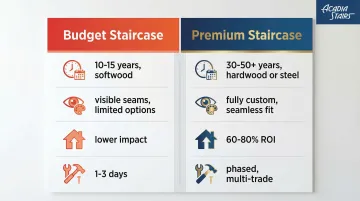
Practical rule: If the staircase is in a high-traffic, high-visibility space (main entry, open-plan living), the investment in quality pays back. If it's a secondary staircase in a rental or storage context, budget-tier is likely the rational choice.
What Most People Get Wrong When Budgeting for a Staircase
Mistake 1: Focusing Only on Material Cost
Many homeowners get a quote for stair parts and assume that's the total cost. Labor often equals or exceeds the material cost, especially for complex shapes or custom metalwork. That $8,000 material quote can become $15,000 once installation is factored in.
Mistake 2: Underestimating Ripple Costs
Replacing a staircase often triggers adjacent work that wasn't in the original budget:
- Floor patching where the old stringer sat: $300–$800
- Wall repair and repainting: $200–$600
- Structural reinforcement if beams or joists need strengthening: $500–$2,500
- Lighting or electrical adjustments: $150–$500 per fixture
Budget an additional 15-20% contingency on top of the staircase quote to cover these surprises.
Mistake 3: Ignoring Total Lifecycle Cost
A budget staircase that needs refinishing every five years—or tread replacement within a decade—can cost more over 20 years than a premium staircase bought once. A cost-per-year comparison makes the real value clear:
| Staircase | Total Cost | Lifespan | Cost Per Year |
|---|---|---|---|
| Budget option | $5,000 | 10 years | $500/year |
| Premium option | $15,000 | 40 years | $375/year |
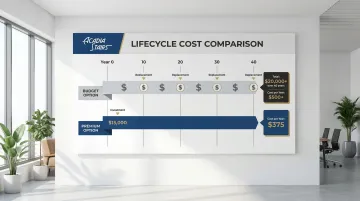
The premium option costs less annually and holds its appearance throughout.
Frequently Asked Questions
What is the average cost of a new staircase?
Average cost depends heavily on shape and materials, but most residential staircases fall between $3,000 and $30,000 for complete installation. Custom or curved designs exceed this significantly, often reaching $50,000-$100,000+ for high-end architectural installations.
What type of staircase is the cheapest to build?
A straight staircase using standard softwood or basic hardwood materials is the most cost-effective configuration. It requires the least fabrication complexity, no intermediate support structuring, and the fewest labor hours, making it ideal for budget-conscious projects.
Does a new staircase add value to a home?
Yes, especially in high-visibility areas like open-plan or architecturally distinctive homes. ROI typically ranges from 60-80%, so treat it as a functional upgrade and a lifestyle investment — not purely a financial one.
Is it cheaper to repair or replace a staircase?
For cosmetic fixes, minor repairs often cost just a few hundred dollars. But if the structure is compromised or the design is significantly outdated, a full replacement typically delivers better safety, longevity, and return on investment.
How long does staircase installation take?
A basic straight staircase installation typically takes 1-3 days for demolition and installation. Complex custom or curved installations can take 1-3 weeks on-site, not including the 2-4 week lead time for fabricating custom steel or glass components off-site.
What material is best for a long-lasting staircase?
Powder-coated steel and premium hardwoods like white oak or walnut are top choices for durability and low maintenance. Steel holds up for 30+ years with minimal upkeep; quality hardwoods can be refinished repeatedly across a 40-50 year lifespan.