Introduction
Every year, more than 38,000 older adults die from unintentional falls in the United States, with millions more requiring emergency treatment for fall-related injuries. According to the National Safety Council, falls rank as the second leading cause of preventable injury-related death nationwide. These statistics make one thing clear: stair design isn't just about aesthetics—it's a matter of life and safety.
Glass stairs have surged in popularity across modern residential and commercial design, prized for their ability to flood spaces with light and create striking visual impact. Their transparent beauty does introduce unique safety considerations that demand careful attention.
When properly designed and installed, though, glass staircases deliver both exceptional style and structurally sound, code-compliant performance—no trade-offs required.
This guide covers the style decisions that make glass stairs stunning and the safety practices that keep them structurally sound and code-compliant, from material selection through daily maintenance.
Key Takeaways
- Tempered or laminated safety glass is required—standard glass is never acceptable for stair applications
- All glass stairs must meet local building codes for load capacity and railing height
- Glass type, frame finish, and tread surface all affect both safety and appearance
- Regular maintenance is a safety discipline, not just cosmetic upkeep
- Professional installation is essential; it's one of the most common points of failure
Style Essentials for Modern Glass Stairs
The visual impact of a glass staircase starts with choosing the right system configuration. Three dominant styles shape the modern glass stair market, each creating distinct aesthetic effects and structural requirements.
| System Type | Structure | Glass Thickness | Best For |
|---|---|---|---|
| Frameless (standoff/clamp) | Base shoes, spigots, or standoff pins — no vertical posts | ½"–¾" laminated | Residential interiors, luxury builds |
| Semi-frameless | Vertical posts or clips share the load; no top rail | Slightly thinner than frameless | Commercial spaces, wind-exposed exteriors |
| Framed (channel-set) | Metal or wood frame on 2–4 sides carries the load | ¼" minimum | High-traffic public areas, budget-conscious projects |
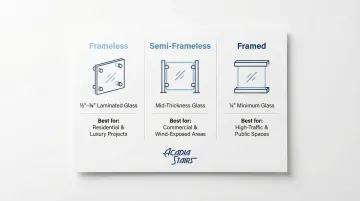
Frameless systems command premium pricing because the glass does the structural work — panels must be thick enough to resist loads without deflection. Semi-frameless configurations hit a practical middle ground for commercial staircases where wind loads demand extra support. Framed systems reduce material costs significantly, making them the go-to for busy lobbies and public installations.
Tread Materials That Complement Glass
The material you pair with glass panels fundamentally shapes your staircase's design language:
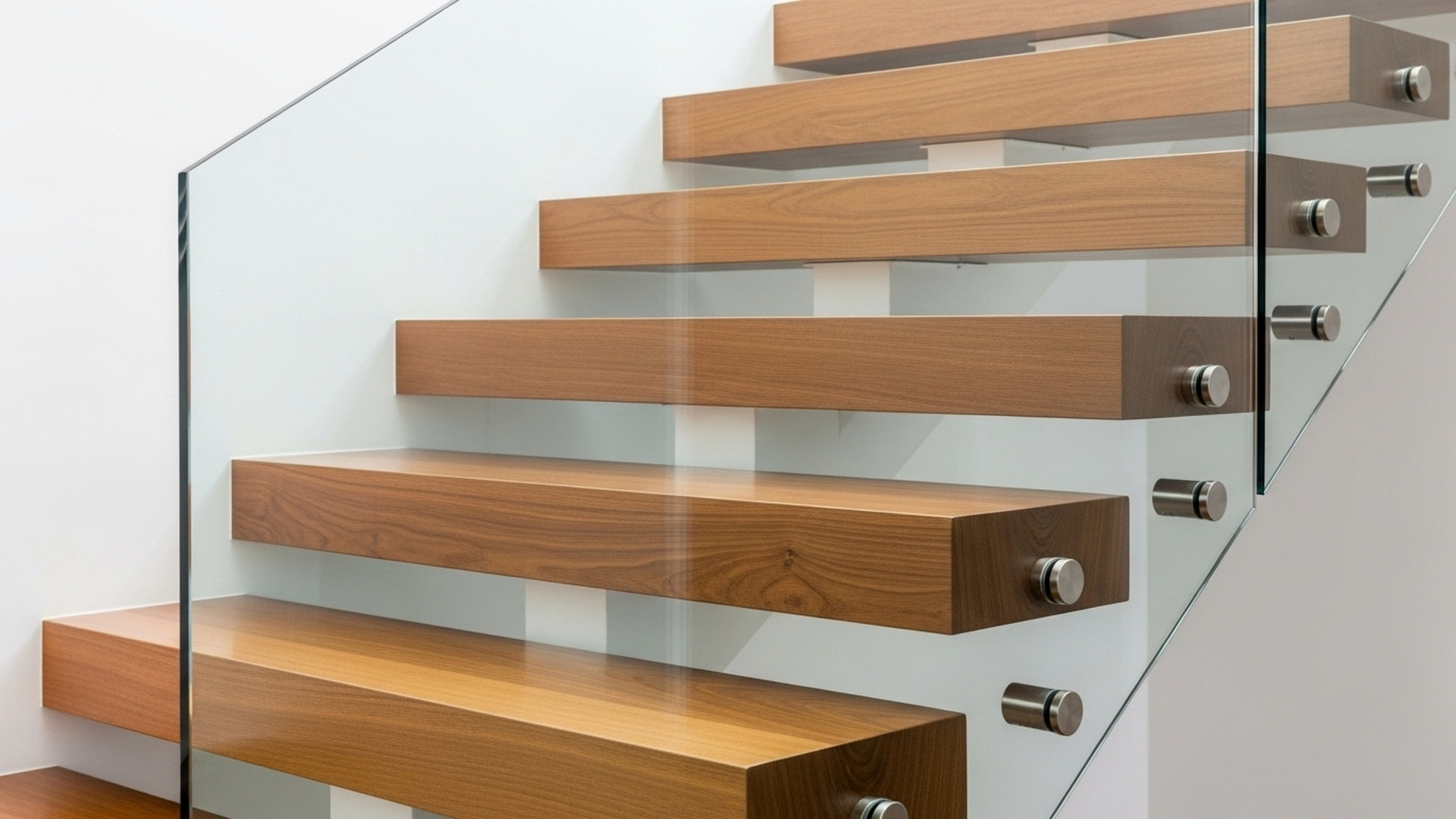
- Wood treads (oak, walnut, maple) against frameless glass create a transitional look—warm and inviting while maintaining modern lines
- Steel treads deliver industrial-modern aesthetics, especially when powder-coated in matte black or left with a raw steel finish
- Stone treads (granite, bluestone) provide timeless elegance and exceptional durability for high-traffic commercial lobbies
- Composite materials offer practical weather resistance for exterior applications without sacrificing contemporary style
Acadia Stairs builds custom glass staircases across all three system types, with tread material options matched to your space, traffic level, and design goals.
How Glass Stairs Interact with Architecture
Open risers maximize light flow and visual continuity, allowing sight lines to pass through the staircase. This configuration works beautifully in open-plan homes where the staircase shouldn't obstruct views or natural light paths.
Closed risers provide a more traditional appearance while still benefiting from glass railing transparency. They're ideal when you want the modern appeal of glass without the fully exposed floating effect.
Floating stair configurations with glass railings rank among the most dramatic modern options. Single-stringer designs create the impression that treads hover in mid-air, with transparent glass railings amplifying the weightless effect.
Hardware Finishes and Design Consistency
Hardware details carry through your entire design scheme. Common finish options include:
- Matte black for bold contemporary contrast
- Brushed stainless steel for timeless modern appeal
- Polished chrome for high-gloss luxury environments
Pick your glass system's finish first, then match door hardware, light fixtures, and other metal elements to it. Mismatched finishes — say, polished chrome standoffs against matte black door handles — pull focus away from the staircase itself.
Privacy Without Sacrificing Light
Frosted, tinted, or patterned glass panels offer visual separation in open-plan homes or commercial lobbies where complete transparency isn't desired. These treatments maintain light transmission while providing privacy—particularly valuable in multi-story homes where stairs overlook living areas or in commercial spaces where discrete separation between public and private zones matters.
Glass Types and Safety Standards
Understanding glass specifications isn't optional—it's the foundation of every safe glass staircase.
Tempered vs. Laminated Glass
Tempered glass undergoes heat treatment that makes it approximately four times stronger than standard annealed glass. When it breaks, it shatters into small, granular chunks rather than dangerous shards. However, once broken, tempered glass falls away completely, creating an immediate fall hazard. The International Building Code restricts tempered-only glass for this reason.
Laminated glass bonds two or more glass layers with an interlayer (typically PVB or SGP). If broken, fragments adhere to the interlayer, keeping the panel intact and maintaining a barrier even after failure. This post-breakage behavior is why IBC Section 2407.1 mandates laminated glass for handrails and guards in most applications.
For structural glass stair applications, laminated tempered glass is the required combination—pairing the strength of tempering with the retention safety of lamination.
Minimum Thickness Requirements
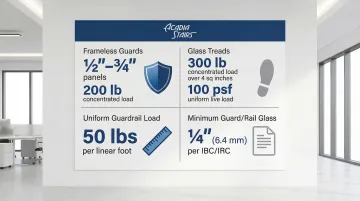
Both IBC and IRC require a nominal minimum of ¼ inch (6.4 mm) for any glass used in handrails or guards. Frameless systems typically need much thicker panels to meet structural demands without excessive deflection.
Key thickness and load benchmarks:
- Frameless guards: ½ inch to ¾ inch panels to meet the 200 lb concentrated load requirement
- Glass treads: Must support a 300 lb concentrated load applied over 4 square inches
- Uniform live load: 100 psf required for tread applications
- Minimum for any guard/rail glass: ¼ inch (6.4 mm) per IBC/IRC
Never specify glass based solely on minimum thickness. Always base thickness decisions on engineering calculations for your specific span width, support configuration, and expected loads.
Safety Glazing Certification
Two standards govern safety glazing in the US: ANSI Z97.1-2015 covers impact resistance, thermal performance, and weathering; CPSC 16 CFR Part 1201 classifies glazing into Category I and II based on impact resistance.
IBC Section 2407.1 requires compliance with Category II of CPSC 16 CFR Part 1201 or Class A of ANSI Z97.1. Inspectors check for permanent labels (etched or ceramic frit) on each panel containing:
- Manufacturer/installer name or SGCC ID number
- Safety standard designation ("ANSI Z97.1-2015" and/or "16 CFR 1201 II")
- Glass type and nominal thickness
- Impact classification (e.g., "Class A" or "Category II")
Load-Bearing Capacity Standards
Guardrail loads: Glass guards must withstand a 200 lb concentrated load applied at any point in any direction, plus a uniform load of 50 lbs per linear foot. Glass guards must be designed using a safety factor of four.
Stair tread loads: A common misconception claims treads must support 300 pounds per square foot. The actual requirement is a 300 lb concentrated load (applied over 4 square inches) plus a 100 psf uniform live load—significantly different specifications that affect engineering calculations.
Working with Experienced Designers
Getting glass specifications right at the design stage prevents costly corrections during fabrication or installation. Acadia Stairs has worked through these engineering requirements on custom glass staircase projects across the US since 2011—coordinating glass type, thickness, and certification before a single panel is ordered.
Safety During Installation and Daily Use
Glass stair safety depends on two distinct phases: the installation process (where structural integrity is determined) and ongoing daily use (where behavioral and maintenance habits matter).
General Safety Precautions
Baseline safety conditions must be met before any glass stair project begins:
- Confirm that stringers, mounting points, and framing are engineered to support glass panel loads before glass is ordered or installed
- Check that all clamps, standoffs, and anchors are rated for the specific glass weight and thickness being used
- Apply etched, sandblasted, or anti-slip surfaces to every glass tread — this is a code requirement in most jurisdictions and essential for preventing falls in wet or high-traffic conditions
Slip resistance is often treated as optional. It isn't — skipping it puts occupants at risk and puts the project out of code compliance.
Safety During Installation
Key installation risks include:
- Even millimeter-level sizing errors create stress concentrations that can cause spontaneous fracture under load
- Shallow anchoring creates leverage points that dramatically magnify applied forces at the mount
- Over-tightened clamps can stress-fracture tempered glass with no visible warning beforehand
- Glass should never contact metal or concrete directly — neoprene or silicone setting blocks must isolate every edge to prevent damage at contact points
Glass stair installation should never be a DIY project. Structural miscalculation or improper seating of glass panels can cause catastrophic failure without visible warning signs prior to collapse.
Safety During Daily Use and Maintenance
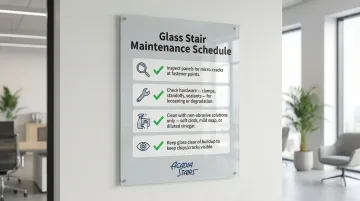
Regular maintenance is a safety discipline, not just a housekeeping task:
- Inspect glass panels periodically for micro-cracks and stress marks at fastener points
- Check hardware connections for loosening clamps, shifting standoffs, and degraded sealants — any of these warrant professional evaluation before the stair is used further
- Avoid abrasive cleaners — they scratch glass and gradually weaken structural integrity; soft cloths with mild soap or a diluted vinegar solution work well
- Keep glass free of buildup so chips or cracks stay visible — early detection is the easiest form of damage control
Hardware inspection matters especially in humid or outdoor environments where standoffs, clamps, and anchors can corrode. Corroding hardware rarely signals failure dramatically — by the time a problem is visible, structural integrity may already be compromised. Routine inspection is the only reliable safeguard.
Common Safety Mistakes to Avoid
Even well-designed glass staircases can become hazards when corners are cut during specification, permitting, or maintenance. These are the three most common mistakes to avoid:
- Prioritize glass certification, not just appearance. Thinner or non-certified panels are among the most frequently cited causes of railing and tread failure. Confirm any glass meets structural and safety glazing standards (look for CPSC 16 CFR 1201 or ANSI Z97.1 certification) before committing to a frameless look.
- Pull the permits. Glass stairs require building code review in virtually every jurisdiction. Skipping this step creates legal liability at resale and leaves you exposed if an injury occurs.
- Inspect mounting hardware every 6-12 months. Standoffs, clamps, and anchors carry continuous load and corrode over time — often without obvious warning signs. Coastal installations need more frequent checks due to salt air exposure.
Conclusion
Modern glass stairs achieve their signature look only when style decisions and safety specifications are treated as inseparable. The glass type, the installation method, the hardware quality, and the ongoing maintenance all contribute equally to a staircase that is both visually striking and structurally dependable — and getting both right starts with the right team at the design stage.
Acadia Stairs brings over 40 years of combined experience to custom staircase design, including projects that incorporate glass elements into metal structures built to exact specifications. Every build is tailored to the space, the aesthetic vision, and the applicable safety requirements from the first conversation onward.
Reach out to their design consultants at (845) 765-8600 or info@acadiastairs.com to discuss your project.
Frequently Asked Questions
How much do glass stairs cost?
Glass stair costs vary widely based on glass type (tempered vs. laminated), railing system style (frameless vs. framed), tread material, and custom fabrication requirements. Residential frameless systems typically range from $250 to $700 per linear foot, while complex commercial installations can exceed $850 per linear foot. Laminated glass typically costs twice as much as standard tempered glass.
What are the pros and cons of glass stairs?
Glass stairs offer exceptional light flow, modern aesthetics, durability, and low long-term maintenance. Drawbacks include higher upfront cost, fingerprint visibility requiring regular cleaning, slip risk on untreated glass treads, and the firm requirement for professional installation.
What is the 27 rule for stairs?
The "27 rule" refers to the minimum 27-inch clear width between handrails on both sides of a staircase, per IRC Section R311.7.1, accounting for handrail projection into the walking path. The broader stair width requirement is 36 inches of clear width above handrail height.
Is tempered or laminated glass better for stairs?
Laminated glass is generally preferred for overhead applications and treads because it stays in place if broken, maintaining a barrier and preventing fallout. Tempered glass is common for vertical railing panels where the post-breakage vacant opening risk is lower. The right choice depends on the specific application and local code requirements.
Do glass stairs require special maintenance?
Glass stairs require regular cleaning with non-abrasive solutions and periodic hardware inspection for loose connections or corrosion. Maintenance is lighter than wood, but staying consistent matters — clean glass also makes it easier to spot damage early.
Are glass stairs slippery?
Smooth glass treads are inherently slippery when wet, but etched, sandblasted, or applied anti-slip surfaces address this effectively. Most jurisdictions require anti-slip treatment by code, and properly treated treads can achieve a DCOF of 0.42 or higher for safe wet-surface performance.