Introduction
Your staircase is one of the most-used surfaces in your home—climbed dozens of times daily, bearing furniture during moves, and enduring everything from pet claws to high heels. It's also one of the first architectural features visitors notice. This dual role—structural workhorse and design focal point—makes wood tread selection a decision that demands careful consideration.
With dozens of species available—each with different hardness levels, grain patterns, and price points—the choice is genuinely difficult. Some dent under normal use, others resist stain unpredictably, and many that look stunning in a showroom won't match your existing floors or metal staircase frame.
This guide narrows the field to five species that hold up to foot traffic while elevating your home's aesthetic: Red Oak, White Oak, Hard Maple, Walnut, and Hickory.
Key Takeaways
- Janka hardness above 1,000 lbf is essential for treads that endure daily use without denting
- Red Oak and White Oak balance durability, stainability, and cost across most budgets
- Hard Maple suits contemporary minimalist homes; Walnut suits luxury interiors
- Apply at least 3 coats of polyurethane — finish quality protects treads as much as species selection does
- Match tread wood to your existing flooring or staircase frame material for a cohesive, intentional look
What Makes a Wood Species Ideal for Stair Treads?
Not all hardwoods are created equal when it comes to stair treads. The right species must resist denting, handle moisture fluctuations, and accept your desired finish—all while fitting your budget.
The Janka Hardness Scale
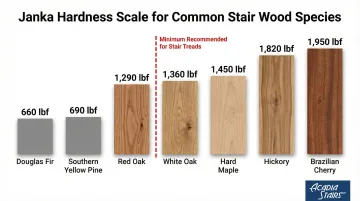
The Janka hardness test measures how much force is required to embed a 0.444-inch steel ball halfway into wood. Results are expressed in pounds-force (lbf), and higher numbers mean better resistance to denting from dropped objects, pet claws, and daily foot traffic.
Industry consensus establishes 1,000 lbf as the minimum acceptable rating for stair treads. This threshold disqualifies most softwoods—Southern Yellow Pine scores just 690 lbf, while Douglas Fir registers 660 lbf. These woods dent easily under normal residential use, making them poor choices unless you're deliberately seeking a distressed, rustic look.
Grain Density and Stability
Grain structure determines how wood reacts to humidity changes—a critical factor for stair treads, which are often unsupported along the nosing edge.
Closed-grain woods like Maple have uniform, tight pores that resist moisture absorption and reduce seasonal movement. Open-grain woods like Oak feature distinct earlywood and latewood bands that create pronounced grain patterns. While open grain absorbs moisture more readily, it hides wear patterns better than smooth, uniform surfaces.
Denser grain also reduces warping, cupping, and the stair creak that develops when wood expands and contracts against fasteners.
Stain and Finish Compatibility
Some species accept stain predictably; others fight it. This matters when matching existing flooring or achieving a specific tone.
- Open-grained woods (Red Oak, White Oak) absorb liquid stain evenly, making them versatile for traditional through contemporary styles
- Closed-grain woods (Maple) resist stain penetration, often resulting in blotchy, uneven color—they perform best with clear or light natural finishes
- Naturally dark woods (Walnut) require little to no staining, offering rich color straight from the mill
Knowing which category your chosen species falls into before buying saves you from refinishing work down the road.
Budget vs. Longevity Trade-Off
Lower-cost species can still outperform pricier options under typical residential conditions. Red Oak—one of the most affordable domestic hardwoods—outlasts some exotic species that struggle with North American humidity levels.
The better metric is cost-per-year-of-service, not sticker price. Consider:
- A $45 Red Oak tread lasting 25+ years costs roughly $1.80/year
- An $85 exotic tread needing refinishing after 10 years runs closer to $8.50/year—before refinishing costs
The math usually favors proven domestic species over exotic alternatives with unproven performance in your climate.
Best Wood Species for Stair Treads
The five species below represent the most reliably recommended options based on hardness, availability, design versatility, and real-world performance in residential and commercial staircases.
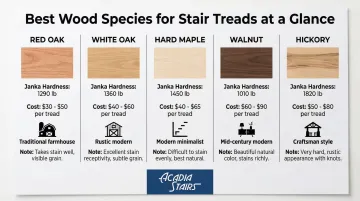
Red Oak
Red Oak dominates the North American hardwood market for good reason: it offers proven durability, wide availability, and design versatility at a competitive price point.
Red Oak features pronounced open grain with warm reddish-brown tones. Its porous structure absorbs stain reliably, making it adaptable across traditional, transitional, and farmhouse design styles. The species resists warping and has been the residential flooring standard for decades.
Most lumber suppliers stock Red Oak as prefinished treads, reducing lead times and installation complexity. It's the practical default for budget-conscious renovations that won't compromise on durability.
| Attribute | Details |
|---|---|
| Janka Hardness Rating | 1,290 lbf |
| Typical Cost Range | $34–$45 per tread |
| Best Style Match | Traditional, farmhouse, transitional interiors |
Red Oak accounts for approximately 45% of domestic hardwood flooring and stair usage — the number that explains why it's the default starting point for most stair projects.
White Oak
White Oak has surged in popularity alongside modern and Scandinavian-influenced interiors, thanks to its neutral tones and superior physical properties.
White Oak offers tighter grain and a golden-olive tone less red than its cousin. Its heartwood contains tyloses (tiny structures that seal the wood's pores), reducing liquid absorption by approximately 30% compared to Red Oak. That makes White Oak nearly waterproof and the better choice for areas with humidity variation or floating tread designs.
It also accepts wire-brushed and matte finishes well, creating the textured, natural aesthetic favored in contemporary design. The neutral color complements both warm and cool palettes.
| Attribute | Details |
|---|---|
| Janka Hardness Rating | 1,360 lbf |
| Typical Cost Range | $40–$55 per tread |
| Best Style Match | Modern, Scandinavian, transitional interiors |
Specification data points to a 23% rise in White Oak use for interiors in recent years, tracking closely with demand for lighter finishes alongside powder-coated steel stringers.
Hard Maple
Hard Maple ranks among the hardest domestic hardwoods available, offering exceptional dent resistance for high-traffic contemporary staircases.
Hard Maple features very fine, uniform grain with a light creamy-white to pale blonde color. Its density creates a smooth surface ideal for minimalist design, and it resists denting under heavy foot traffic better than both Oak varieties.
One important caveat: Maple's dense, non-porous surface resists liquid stain penetration. Attempting dark stains often results in blotchy, uneven color. Maple performs best with clear or light natural finishes that showcase its pale, clean appearance — worth knowing before committing to the species.
| Attribute | Details |
|---|---|
| Janka Hardness Rating | 1,450 lbf |
| Typical Cost Range | $60–$75 per tread |
| Best Style Match | Contemporary, modern, minimalist interiors |
If your design vision includes dark wood treads, choose Oak or Walnut instead. If you want light, clean lines that create striking contrast with dark metal railings, Maple is unmatched.
Walnut
Walnut represents the premium choice for luxury staircase applications where visual impact takes priority.
Walnut offers rich chocolate-brown heartwood with distinctive straight-to-wavy grain. Its natural color requires little to no staining to achieve a polished, finished look. While softer relative to Oak and Maple, its hardness holds up fine for residential stair tread use with proper finishing.
It pairs particularly well with dark metal hardware and glass railings. The contrast between Walnut's warm brown tones and matte black powder-coated steel is a go-to combination in upscale modern and contemporary projects.
| Attribute | Details |
|---|---|
| Janka Hardness Rating | 1,010 lbf |
| Typical Cost Range | $84–$120 per tread |
| Best Style Match | Luxury, contemporary, mid-century modern interiors |
Walnut sits at the higher end of domestic hardwood pricing but delivers unmatched aesthetic impact for clients prioritizing design over maximum hardness.
Hickory
Hickory is the hardest commonly available domestic hardwood, offering exceptional resistance to impact and wear.
Hickory features dramatic contrast between light sapwood and dark heartwood with strong, bold grain patterns. That visual boldness pairs with equally exceptional dent resistance, making it the top pick for very high-traffic homes or anyone wanting a rustic, characterful aesthetic.
The trade-off is installation difficulty. Hickory's extreme density requires carbide-tipped tools and pre-drilled nail holes to prevent splitting — professional installation is worth budgeting for. Its bold color variation also suits specific rustic and craftsman styles rather than broad applications.
| Attribute | Details |
|---|---|
| Janka Hardness Rating | 1,820 lbf |
| Typical Cost Range | $46–$112 per tread |
| Best Style Match | Rustic, craftsman, industrial, high-traffic residential |
For homes with large dogs or exceptional foot traffic, Hickory's hardness justifies the installation challenges and bold aesthetic.
How to Match Wood Treads to Your Staircase Design
Choosing the right species matters—but so does how that tread connects to your existing floors, finish palette, and staircase structure.
The Principle of Visual Continuity
When wood treads connect to existing hardwood floors, matching species and stain tone creates visual continuity between levels. An exact match isn't always possible—especially when integrating new treads with older floors that have aged or oxidized.
When an exact match isn't possible, choose complementary tones over clashing ones. Pair warm with warm (Red Oak treads with cherry floors) or cool with cool (White Oak treads with gray-stained ash). Finish sheen matters just as much—a mismatch between satin treads and glossy floors disrupts visual flow even when the colors align.
How Stair Frame Material Influences Tread Choice
Modern staircase designs increasingly pair wood treads with metal structures. The frame material should guide your wood selection.
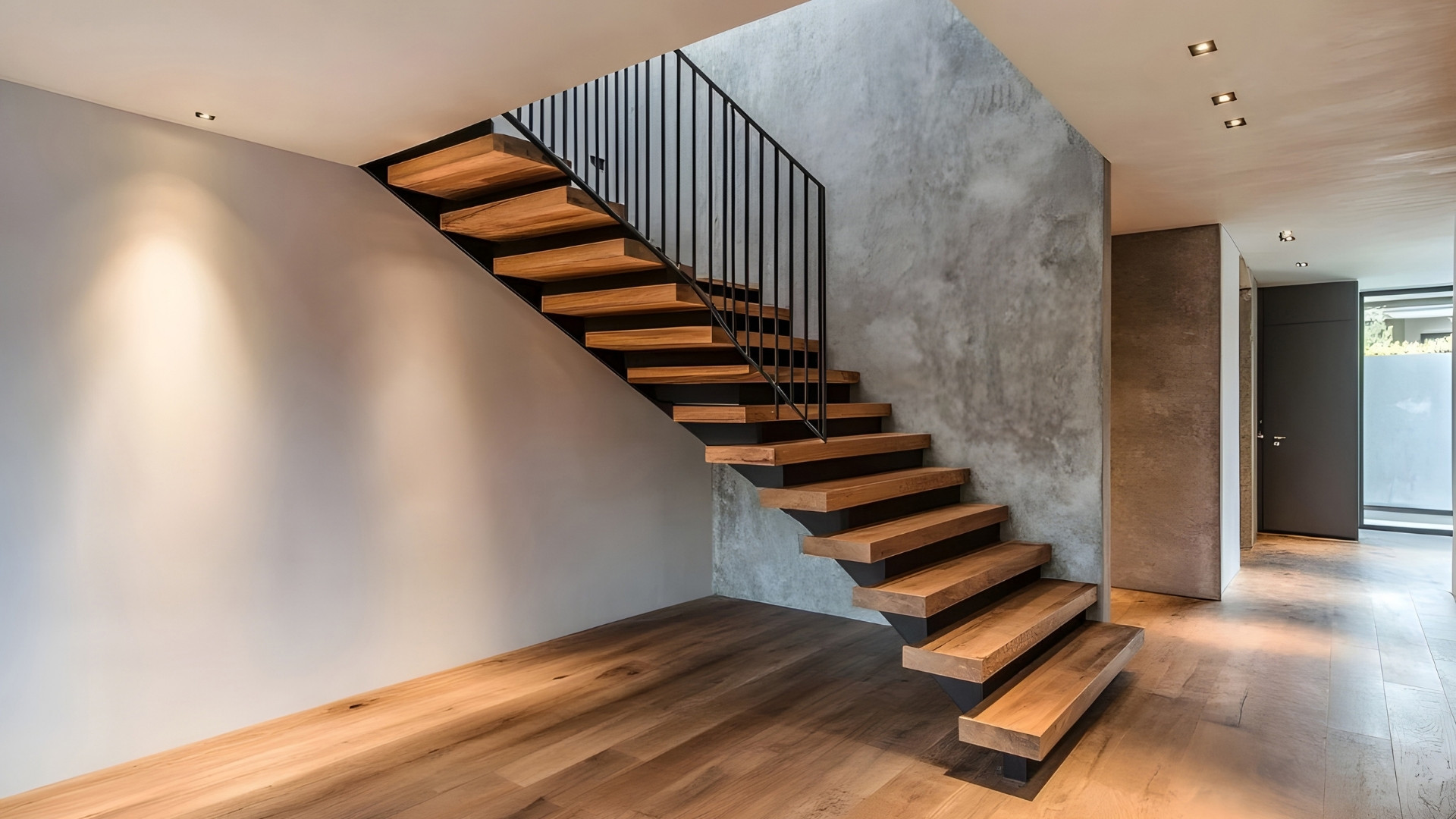
Powder-coated steel stringers (common in contemporary builds like those from Acadia Stairs) create opportunities for striking contrast:
- Lighter species like White Oak or Maple pop against matte black or charcoal powder coating
- Darker Walnut reinforces a sleek, monochromatic palette when paired with black metal
- Natural Hickory adds warmth and texture to industrial-style metal frames
Stainless steel or brushed metal railings pair well with mid-tone species like White Oak, which bridges the gap between metal's cool tones and wood's organic warmth.
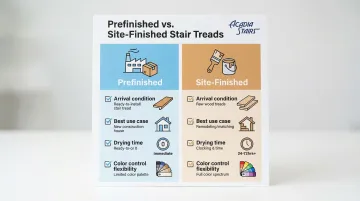
Prefinished vs. Site-Finished Treads
| Prefinished | Site-Finished | |
|---|---|---|
| Arrives | Factory-finished, ready to install | Raw, unfinished |
| Best for | Quick installs, no on-site finishing equipment | Matching existing flooring precisely |
| Drying time | None | 24–48 hours between coats |
| Color control | Limited to available factory options | Full custom staining flexibility |
Best Finish for Wood Stair Treads
Even the hardest wood species will wear prematurely without adequate surface protection. Stair treads experience concentrated directional pressure, shoe abrasion, and grit accumulation—demanding more durable finishes than typical hardwood flooring.
Three Main Finish Categories
| Finish Type | Hardness | Wear Resistance | Recoat Time | Full Cure | Best For |
|---|---|---|---|---|---|
| Oil-Based Polyurethane | ~2H (pencil) | Excellent; ambers over time | 8–12 hrs | 7–14 days | Maximum durability, flexible timeline |
| Water-Based Poly (2K) | ~3H (König) | Excellent; non-yellowing | 2–3 hrs | 3 days | Fast-track projects, color-sensitive woods |
| Hardwax Oil | ~1.5H (König) | Moderate; easy spot repair | 6–8 hrs | ~7 days | Natural matte look, low-maintenance upkeep |
Sheen Options
- Matte/Satin: Hides scratches and wear patterns best; recommended for high-traffic stairs
- Semi-Gloss: Moderate sheen; shows scratches more readily
- Gloss: Highest sheen; magnifies every imperfection—rarely recommended for stairs
Critical Application Tips
- Apply a minimum of 3 coats—the National Wood Flooring Association recommends this for stair treads to build sufficient film thickness
- Sand lightly between coats with 220-grit to improve adhesion
- Mix fine aluminum oxide or polypropylene granules into the final coat for slip resistance without affecting finish clarity

Conclusion
The best wood for stair treads depends on foot traffic level, design style, budget, and finish compatibility. Prioritizing Janka hardness above 1,000 lbf and applying a minimum of three protective coats will extend the life of any wood tread choice.
Here's a quick reference by use case:
- Red Oak / White Oak — Best all-around choice for most residential projects; durable, workable, and cost-effective
- Hard Maple — Ideal for contemporary or minimalist homes that need maximum dent resistance
- Walnut — Best for luxury interiors where rich, natural color is a design priority
- Hickory — Top pick for high-traffic areas or rustic aesthetic goals
For homeowners and designers combining wood treads with a custom metal staircase structure, Acadia Stairs offers collaborative design support and nationwide shipping. The team works with you to match wood species to your design goals, finish preferences, and structural requirements—so the frame and tread material come together as one cohesive staircase. Reach out at (845) 765-8600 or info@acadiastairs.com to start a consultation.
Frequently Asked Questions
Frequently Asked Questions
What is the most durable wood for stair treads?
Hickory (1,820 lbf) and Hard Maple (1,450 lbf) rank as the top durability picks by Janka hardness. However, White Oak (1,360 lbf) offers the most popular balance of durability, moisture resistance, and workability for most residential projects.
What is the most durable finish for stair treads?
Oil-based polyurethane provides the most wear-resistant finish for stair treads, though it requires longer dry time (7-14 days full cure) than water-based alternatives. Apply at least three coats with light sanding between applications for proper protection.
Can you use softwood for stair treads?
Softwoods like pine can be used but dent and scratch more easily under regular foot traffic (Pine scores just 690 lbf). They're better suited to low-traffic applications or painted stairs where surface damage will be less visible than on natural-finish wood.
How thick should wood stair treads be?
The standard thickness for solid wood stair treads is 1 inch, with 1.25 inches used for added rigidity on floating or open-riser designs. Building codes focus on structural load requirements (300 lbs concentrated load) rather than prescribing a minimum thickness.
Should stair treads match hardwood floors?
An exact match is ideal but not required — complementary wood tones and species work well when matching is impractical. Sheen level often matters as much as color: mismatched finishes (satin treads against glossy floors) can disrupt cohesion more than slight species or stain differences.