Introduction
Get stair dimensions wrong and the consequences stack up fast: failed inspections, fall hazards, voided permits, and a staircase that wears people out on every climb. Get them right and you have something that's safe, code-compliant, and genuinely comfortable to use.
In the US, stair dimensions are governed primarily by the IRC (International Residential Code). These aren't suggestions—deviations create real liability exposure and can void insurance coverage. Understanding each regulated parameter, from rise and run to headroom and nosing, is essential whether you're planning a new build or renovating an existing staircase.
This guide breaks down every code-required dimension, walks through how to calculate them for your specific floor-to-floor height, and explains what it takes to go beyond bare compliance to a staircase that's actually comfortable to climb.
Key Takeaways
- Residential stair rise maxes out at 7¾ inches per IRC; tread depth must be at least 10 inches
- Minimum staircase width is 36 inches (handrails excluded); headroom must clear 6 feet 8 inches at every point
- Riser consistency matters: all risers in a single flight must stay within 3/8 inch of each other
- Nosing projection runs ¾ inch to 1¼ inches — a small detail that affects both safety and code compliance
- Use the rise-run formula (2R + T = 24–26 inches) to go beyond minimums and build stairs that feel natural to climb
- Residential projects fall under the IRC; commercial spaces follow the stricter IBC — know which applies before you build
Standard Dimensions for Every Key Stair Component
Stair dimensions are code-regulated parameters under IRC Section R311.7, the primary US residential construction standard. Deviations create safety hazards, fail inspections, and can void insurance or liability coverage. Every measurement below carries a legal minimum or maximum — and most carry a consistency requirement just as binding as the dimension itself.
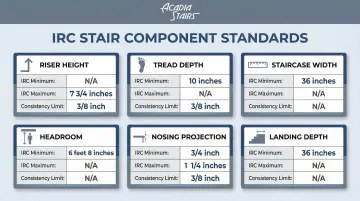
The table below summarizes all key components at a glance before the full breakdown.
| Component | IRC Minimum | IRC Maximum | Consistency Limit |
|---|---|---|---|
| Riser Height | — | 7¾ in | ±3/8 in between risers |
| Tread Depth | 10 in | — | ±3/8 in between treads |
| Staircase Width | 36 in (clear) | — | — |
| Headroom | 6 ft 8 in | — | Maintained throughout full path |
| Nosing Projection | ¾ in | 1¼ in | ±3/8 in between nosings |
| Landing Depth | 36 in | — | Width ≥ staircase width |
Riser Height
The riser is the vertical face of each step, measured from the top of one tread to the top of the next. The IRC sets a maximum riser height of 7¾ inches. Lower risers in the 6–7 inch range are generally easier to climb and reduce fatigue, particularly for older adults or users with mobility limitations.
Consistency is critical: No two risers within the same flight can differ by more than 3/8 inch. Even a small inconsistency causes misstep hazards since the body memorizes the rhythm of a staircase. Research analyzing 80 stair falls found that 60% involved stairs with riser inconsistencies larger than the 3/8-inch permitted limit, directly linking dimensional variation to fall risk.
Tread Depth (Run)
The tread is the horizontal surface stepped on, measured from the nosing to the back of the tread. The IRC requires a minimum depth of 10 inches; optimal comfort is typically achieved at 10–11 inches for residential use.
Tread depth variation across a flight also cannot exceed 3/8 inch, mirroring the riser consistency rule. Inconsistent tread depths are one of the most common triggers for stair-related falls — users don't adjust their foot trajectory to account for irregularities.
In descent specifically, depth inconsistencies reduce foot contact length and increase slip risk. This makes uniformity just as important as hitting the minimum dimension.
Staircase Width
The IRC mandates a minimum staircase width of 36 inches measured clear of handrails, meaning handrails on both sides do not count toward this measurement. Wider stairs (42–48 inches) are common in more spacious residential and commercial settings, improving traffic flow and emergency egress capacity.
When handrails are present on both sides, the minimum clear walking width between them must be at least 27 inches. This is known as the 27-inch rule and ensures adequate passage even when handrails project into the stairway.
Headroom
Headroom is measured vertically from the surface of a tread to the ceiling or structural element directly above it at any point along the staircase. The IRC minimum is 6 feet 8 inches. Tight floor-plan configurations can inadvertently create violations here, so verify clearance during early design before structural decisions lock in.
Headroom must be maintained throughout the full staircase travel path, including at landings. Designers working with basement stairs, attic access, or loft conversions must confirm clearance early to avoid costly structural modifications later.
Nosing Projection
Nosing is the portion of the tread that overhangs the riser below. IRC requirements for nosing:
- Minimum projection: ¾ inch
- Maximum projection: 1¼ inches
- Variation limit: No more than 3/8 inch between the largest and smallest nosing in a flight
Nosing provides toe clearance and increases effective tread depth, contributing directly to stepping comfort. Solid-riser staircases require nosing; open-riser designs follow separate guidelines.
Landing Dimensions
A landing is required at both the top and bottom of every staircase. Its width must be at least equal to the staircase width; its depth (measured in the direction of travel) must be at least 36 inches.
Landings serve a functional safety role by interrupting a fall and allowing safe changes in direction. For staircases with doors at the top or bottom, the landing must extend beyond the door swing to prevent users from stepping directly into a door's path.
The Rise-Run Comfort Formula: Designing Beyond Code Minimums
Meeting code minimums is the floor, not the ceiling. A staircase can be fully IRC-compliant yet feel steep, cramped, or physically taxing—especially for older users or those with mobility considerations. This is where the rise-run comfort formula becomes the real design tool.
The Comfort Formulas
Two commonly used formulas create a natural stride rhythm:
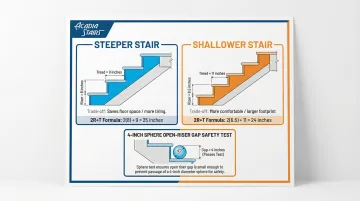
- 2R + T = 24–26 inches (where R = riser height and T = tread depth)
- R + T = 17–18 inches
The first formula, attributed to François Blondel (1675), is derived from the length of an average human stride. The "sweet spot" is often considered 25 inches. For example, a stair with a 7-inch rise and 11-inch tread gives 2×7 + 11 = 25—within the comfort range.
Practical Trade-Offs
A steeper stair (higher riser, shorter tread) saves floor space but tires users faster. A shallower stair (lower riser, longer tread) is more comfortable but requires more horizontal run. For modern and open-plan homes, this trade-off shapes not just comfort but the entire spatial footprint of the staircase.
Here's how those trade-offs play out against the 2R + T formula:
- 7.5-inch riser + 10-inch tread: 2×7.5 + 10 = 25 inches ✓
- 7.75-inch riser + 10-inch tread: 2×7.75 + 10 = 25.5 inches ✓
- 8-inch riser + 10-inch tread: 2×8 + 10 = 26 inches (at upper limit)
Open Riser Stairs
Open risers represent one of the more visually striking options within that steeper-vs-shallower trade-off—but they carry a specific IRC compliance requirement. The open space between treads cannot allow a 4-inch sphere to pass through, capping the gap at under 4 inches.
For custom metal staircases with floating or open-riser aesthetics, this is a detail that can't be overlooked. Acadia Stairs addresses it through riser space limiters or flanged tread edges, reducing the opening while preserving the clean, open look.
How to Measure and Calculate Your Stair Dimensions
Step 1: Measure Total Rise
Start by measuring total rise—the vertical distance from the finished floor at the bottom of the staircase to the finished floor at the top. Measure to finished floor level (not subfloor) since floor material thickness affects the first and last riser heights. Forgetting to account for finished flooring can throw off your first riser height by ¼ inch or more.
Step 2: Calculate Number of Risers
Divide the total rise by your intended riser height (keep within 7–7¾ inches). Round to the nearest whole number, then back-calculate the exact riser height by dividing total rise by number of risers.
Example:
- Total rise: 108 inches
- Target riser: 7.5 inches
- 108 ÷ 7.5 = 14.4 → round to 14 risers
- Exact riser height: 108 ÷ 14 = 7.71 inches ✓
Step 3: Calculate Total Run
Multiply the number of treads (always one fewer than the number of risers) by your intended tread depth. This gives the horizontal floor space the staircase will occupy—an essential measurement for space planning, especially in tight layouts.
Example:
- 14 risers = 13 treads
- 13 treads × 10 inches = 130 inches (10 feet 10 inches) of horizontal run
Step 4: Verify Headroom Clearance
From the point where the staircase passes under a floor or ceiling structure, measure vertically from the tread nosing to the lowest obstruction above. The clearance must stay at 6'8" or greater along the full staircase travel path.
Working with a Custom Stair Fabricator
For custom staircases—particularly modern metal designs with specific material thicknesses, open risers, or floating tread details—working through these calculations with an experienced stair manufacturer is the most reliable approach.
Acadia Stairs works directly with homeowners, architects, and contractors to translate these measurements into custom-fabricated stair systems built to exact specifications. The team uses 3D renderings and detailed shop drawings to confirm dimensional accuracy before fabrication begins.
Residential vs. Commercial Stair Codes: What Changes
The IRC (International Residential Code) governs one- and two-family detached homes, while the IBC (International Building Code) applies to commercial, multi-family, and public-access buildings. Both are model codes adopted—sometimes with amendments—by local jurisdictions.
Key IBC Differences for Commercial Settings
| Dimension | IRC (Residential) | IBC (Commercial) |
|---|---|---|
| Max Riser Height | 7¾ inches | 7 inches |
| Min Tread Depth | 10 inches | 11 inches |
| Min Width | 36 inches | 44 inches (36" if <50 occupants) |
| Handrails | One side minimum | Both sides (generally) |
| Open Riser Limit | 4-inch sphere | Solid risers (exceptions for 4" or ½" sphere) |
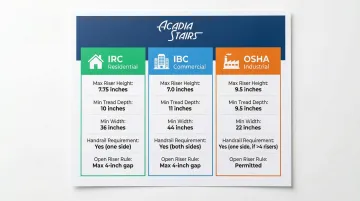
The IBC's tighter numbers exist because commercial stairs must handle high foot traffic, serve people with varying mobility, and support emergency evacuation — conditions that simply don't apply to a single-family home.
OSHA Industrial Standards
For OSHA-regulated industrial environments, requirements differ again under 29 CFR 1910.25. These standards apply to fixed industrial stairs accessing equipment and machinery — not public or residential spaces — and set notably different minimums:
- Max riser height: 9.5 inches
- Min tread depth: 9.5 inches
- Min width: 22 inches
Architects, engineers, and contractors working on commercial or mixed-use projects must verify which code applies before finalizing stair dimensions. Local jurisdictions often adopt amendments that tighten these standards further — so confirming the applicable version early prevents expensive redesigns down the line.
When Stair Dimensions Miss the Mark: Risks and Consequences
Non-compliant stair dimensions don't just fail inspections — they injure people. When geometry is off, the consequences stack up fast: safety hazards, project delays, and legal exposure if someone gets hurt on a staircase that never should have passed review.
The Public Health Impact
Data indicates that stair-related falls result in over 1 million emergency department visits annually in the U.S., with inconsistent dimensional geometry identified as a primary risk factor. Recent National Safety Council data shows that stairs, ramps, landings, and floors account for 69% of home structure injuries—over 3.1 million incidents.
Specific Failure Modes
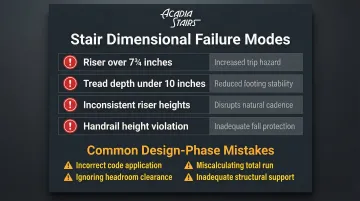
Each dimensional error creates a distinct failure point:
- Riser height over 7¾ inches forces an unnaturally high leg lift, increasing fatigue and fall risk
- Tread depth under 10 inches reduces foot placement security, especially on descent
- Inconsistent risers (beyond 3/8" variation) disrupt the subconscious stride pattern users establish while climbing
- Headroom violations create direct head strike hazards with no warning
Common Design-Phase Mistakes
- Calculating rise from subfloor instead of finished floor
- Ignoring that future floor covering will alter the first or last riser height
- Designing a staircase without confirming the available horizontal run for the total calculated run
- Assuming open-riser aesthetics are automatically code-compliant without verifying nosing and open-space requirements
Code violations found after framing or finishing mean structural rework — not just cosmetic fixes. Catching dimensional errors at the design stage, before a single bracket is set, is almost always the cheaper path.
Frequently Asked Questions
What is the minimum staircase width required by code?
The IRC requires a minimum clear width of 36 inches, measured excluding handrails. When handrails are present on both sides, the minimum clear width between them must be at least 27 inches along the full staircase.
How do I calculate the number of steps I need for my staircase?
Divide your total rise (floor to floor) by your target riser height (7–7¾ inches), round to the nearest whole number, then back-calculate the exact per-riser height by dividing total rise by the number of risers to ensure consistency.
What is the maximum riser height allowed in residential construction?
The IRC maximum is 7¾ inches, with all risers in a flight within 3/8 inch of each other.
What is the difference between IRC and IBC stair requirements?
The IRC applies to one- and two-family homes (max 7¾-inch riser, min 10-inch tread) while the IBC covers commercial and multi-family buildings (max 7-inch riser, min 11-inch tread). Local amendments may impose stricter limits than either model code.
What is the 27-inch rule for stairs?
When handrails are present on both sides, the IRC requires a minimum clear width of 27 inches between the handrails along the full staircase—separate from the overall 36-inch minimum staircase width requirement, which is measured clear of handrails.
Can stairs have open risers, and if so, what is the code requirement?
Open risers are allowed under the IRC, but the open space cannot permit a 4-inch sphere to pass through—meaning the gap must stay under 4 inches.