Whether you're building new or renovating, choosing the right staircase style, materials, and details can transform a transitional space into a true focal point. This guide covers styles, materials, railings, and finishing touches to help you find your perfect design.
Modern staircase design has evolved far beyond the traditional carpeted staircase. Today's options span floating steps, sculptural spirals, mixed materials, and custom metalwork — giving homeowners and designers more creative freedom than ever before. Architectural Digest describes modern staircases as "true pieces of art" that can elevate a basic passageway to a "bold and brag-worthy design element."
TLDR:
- Floating staircases with metal stringers and wood treads are the most popular modern style, creating visual lightness in open-concept spaces
- Material choice dramatically affects aesthetics, durability, and cost — with steel offering 10x the structural strength of wood
- Custom railings (cable, glass, or metal) are the highest-impact design detail for personalizing your staircase
- Integrated LED lighting and under-stair storage transform staircases from functional to architecturally dramatic
Popular Staircase Styles to Consider
Staircase "style" encompasses both the physical shape/configuration and the aesthetic look. Choosing the right combination sets the tone for the entire space, influencing everything from traffic flow to visual impact.
Straight Staircases
Straight staircases are the most common and cost-effective configuration : clean, direct, and adaptable to virtually any interior style from traditional to ultra-modern. They work especially well in narrow or rectangular floor plans where space efficiency is paramount.
The simplicity of straight designs makes them ideal for DIY-friendly installations and straightforward construction. They require minimal engineering complexity compared to curved or spiral alternatives, translating to lower fabrication costs and faster installation timelines.
Floating (Open-Riser) Staircases
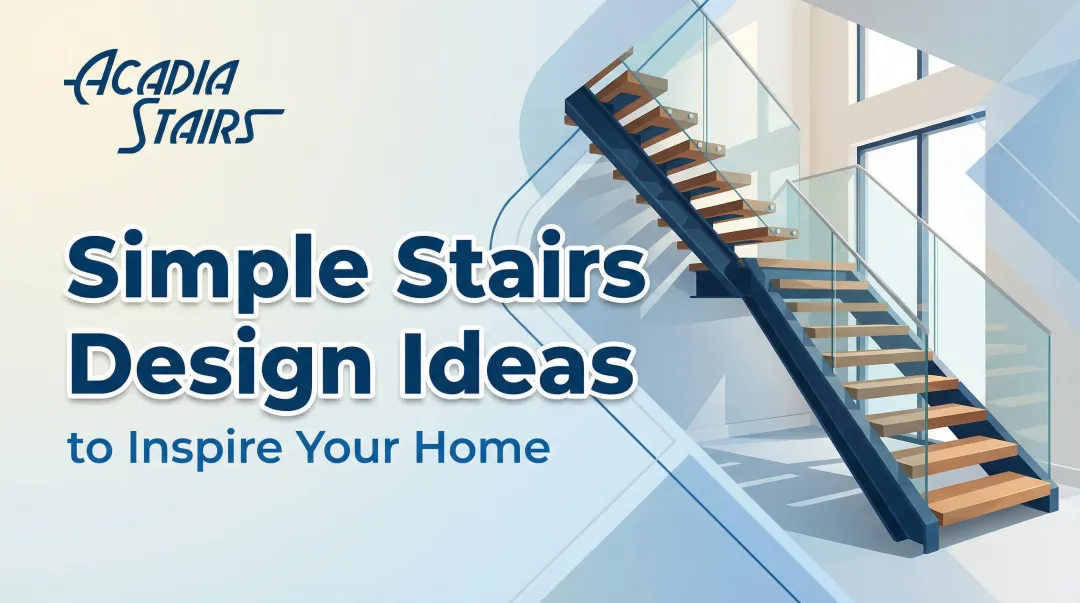
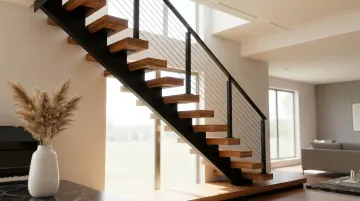
Floating staircases, where treads appear to cantilever from the wall with no visible risers, create a dramatic, open, contemporary look that allows light to pass through the staircase. This style is ideal for open-concept living areas and spaces where visual lightness is a priority.
According to Houzz's design showcase, there's been a "sharp uptick" in floating and open-riser designs for their modern aesthetic and ability to maximize light. These staircases often feature hidden steel stringers or single heavy-duty center beams that support up to 300 pounds per tread while maintaining the illusion of defying gravity.
The open-riser design visually expands airspace, making them particularly effective in smaller homes or lofts where maintaining sightlines across multiple rooms makes rooms feel larger than their square footage suggests.
Spiral and Curved Staircases
True spiral staircases feature a tight helix radiating from a central pole, often used as secondary stairs or in small footprints. The International Residential Code specifies a minimum clear width of 26 inches below the handrail for spiral stairs, with each tread requiring at least 6.75 inches of depth at the walkline.
Curved or sweeping staircases, by contrast, feature grand, wide-radius arcs suited to formal entryways. Unlike spirals, curved stairs must meet standard residential width requirements (typically 36 inches minimum) and can rotate anywhere from a few degrees to a full 360 turns.
Their gradual curvature is noticeably more comfortable to climb than a tight spiral, and the sweeping silhouette doubles as an architectural focal point — the kind that anchors a foyer or great room on its own.
L-Shaped and U-Shaped Staircases
L-shaped (quarter-turn) and U-shaped (half-turn) staircases incorporate landings, making them safer for families and more visually interesting than a straight run. The landing space can be repurposed as a reading nook, display area, or a natural place to pause mid-climb.
These configurations fit well into corner spaces and provide privacy by changing direction mid-flight. Key practical advantages include:
- Breaks up the visual mass of a long staircase run
- Creates natural stopping points that reduce the perceived height of the climb
- Fits neatly into corner floor plans without consuming central living space
- Offers a built-in landing that can double as a display or seating area
Double (Dual) Staircases
Dual staircases make an immediate architectural statement: two symmetrical stairways converging at a shared landing, most often seen in formal foyers and large open-concept homes. This bifurcated design creates dramatic effect when paired with statement lighting and high ceilings.
The split configuration allows traffic to move in multiple directions simultaneously — practical for high-traffic commercial lobbies or large residential estates where several people need upper-floor access at once.
Materials That Define Your Staircase's Look and Feel
The materials you choose for treads, stringers, and structural elements affect not just aesthetics but also durability, maintenance, acoustics, and cost — making material selection one of the most important decisions in staircase design.
Wood
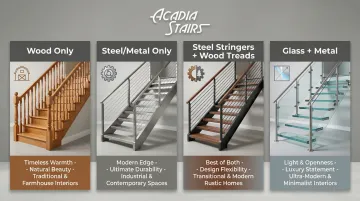
Wood remains the most traditional and versatile staircase material. Light oak and ash create a Scandinavian or farmhouse look, while rich walnut and mahogany add warmth and luxury. Common species vary significantly in hardness and character:
- Red Oak (Janka 1290) — the industry benchmark for durability and affordability
- Hickory (Janka 1820) — significantly harder, excellent for high-traffic areas
- Brazilian Walnut (Janka 3680) — exceptional wear resistance for demanding installations
Wood pairs beautifully with metal railings for modern contrast. However, wood requires periodic finishing to maintain its appearance and is susceptible to decay and insect attack if untreated. Heartwood species like Redwood and Cedar offer better natural resistance without extra treatment.
Metal (Steel and Stainless Steel)
Steel and stainless steel define modern and contemporary staircase design. Steel has an ultimate yield strength approximately 10 times greater than wood, allowing for thinner profiles, floating-tread configurations, and greater sculptural freedom.
Metal stringers enable sleek contemporary aesthetics while providing superior structural stability. Steel is resistant to rot, warping, and pests, making it ideal for long-term durability. For exterior applications or harsh environments, stainless steel offers exceptional corrosion resistance.
Powder coating adds extensive color options and lasting protection. The process forms a thick, uniform barrier that resists corrosion, UV radiation, and mechanical damage — and is twice as thick as standard paint. AAMA 2604 and AAMA 2605 standards ensure long-term color and gloss retention.
Acadia Stairs offers powder coating in nearly any color through suppliers including Prismatic Powders, Tiger Drylac, and RAL Colors, with a batch oven that handles components up to 20 feet long.
Glass
Glass panels — used as railing infill or even as treads — introduce transparency and allow light to flow through the staircase, making them popular for modern and minimalist interiors. The 2018 International Building Code Section 2407.1 mandates that glass used in handrails or guards must be laminated glass constructed of fully tempered or heat-strengthened glass, complying with Category II of CPSC 16 CFR Part 1201.
Building codes require tempered or laminated glass for safety, with monolithic tempered glass permitted only where no walking surface exists below or the area is permanently protected from falling glass.
Stone and Tile
Stone (marble, slate, concrete) and tile treads add weight, permanence, and a sense of luxury — often used in grand entries or commercial spaces. These materials convey solidity and sophistication, particularly when paired with metal or glass railings for contemporary contrast.
Non-slip finishes are essential for safety on smooth stone surfaces. The Tile Council of North America provides specific installation handbooks to ensure proper performance and longevity.
Mixed Materials
Combining materials — wood treads with steel frames, glass railings with stone treads — has become a defining approach in contemporary staircase design. Design showcases frequently feature steel stringers paired with wooden treads or glass treads with metal supports to achieve a light, industrial look.
Mixed materials allow homeowners to blend warmth with industrial edge or traditional charm with modern structure. Steel's structural stability combined with wood's natural warmth creates balanced aesthetics that suit contemporary and transitional interiors. Acadia Stairs fabricates steel stringers with wood tread options including Red Oak, White Oak, Maple, Cherry, Mahogany, and Walnut — all provided natural and pre-sanded, ready for field treatment.
Railing, Baluster and Hardware Ideas
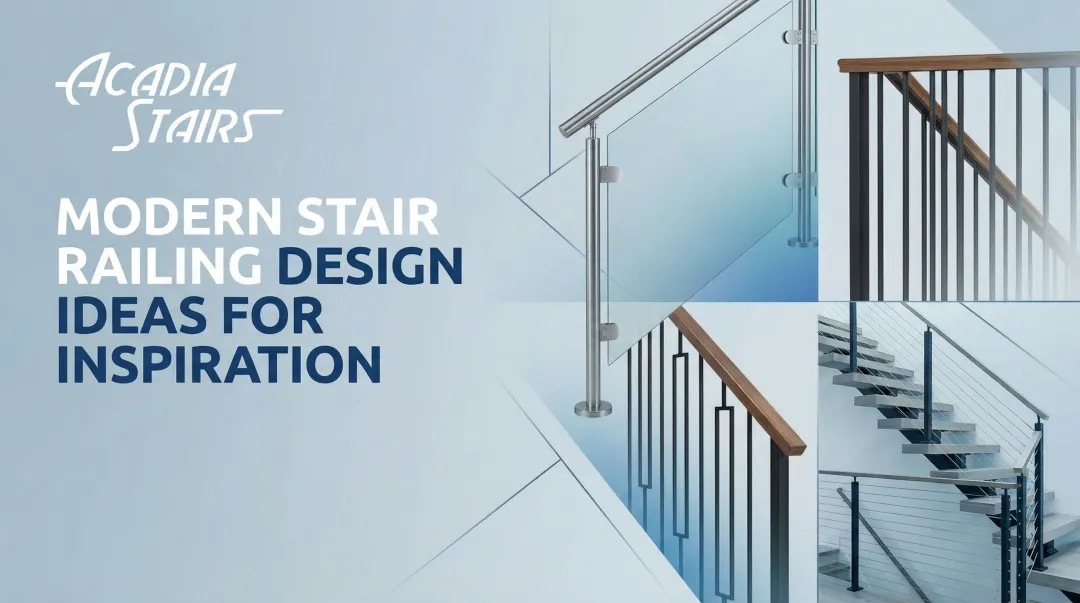
Railings and balusters are the most visible design detail of any staircase and offer one of the highest-impact, most cost-effective ways to update or personalize a staircase's look.
Popular Railing Options:
- Wrought Iron or Steel Balusters: custom scrollwork and geometric patterns suit traditional or eclectic interiors
- Horizontal Cable or Rod Systems: #316 marine-grade stainless steel cables deliver a sleek look for industrial and contemporary spaces
- Glass Panels: preserve sightlines while providing safety — ideal for minimalist or coastal aesthetics
- Minimal Stainless Steel Posts: ultra-clean lines for modern interiors, available in mill finish, glass bead blasted, or #4 brush finish
Code Requirements:
Key residential and commercial code specs to know:
- Residential guards: minimum 36 inches high; commercial requires 42 inches
- Openings must not allow passage of a 4-inch diameter sphere
- Triangular opening (riser, tread, bottom rail): limited to a 6-inch sphere
- Handrail height: 34–38 inches measured vertically from the sloped plane at the tread nosing
Handrail Profile and Finish:
Handrail profiles include round, rectangular, and contoured options. The handrail's finish — whether matte black, brushed nickel, natural wood, or powder-coated color — ties the railing system to the rest of the space. Acadia Stairs fabricates custom railings in panels up to 20 feet long with vertical balusters, solid lines, stainless steel cables, decorative spindles, or glass panels — all engineered with elbows, turn-outs, and goosenecks for strength and ease of installation.
Finishing Touches: Lighting, Color and Decorative Details
Integrated Stair Lighting
Well-placed lighting transforms a staircase from purely functional to architecturally dramatic. The Illuminating Engineering Society recommends a minimum of 100 lux (approximately 10 foot-candles) for stairways to ensure safety, while the IRC requires at least 1 foot-candle at the center of treads and landings.
Lighting Options:
- Recessed step lights — installed in risers or along stringer walls for subtle illumination
- LED strip lighting under treads — creates floating effect while providing visual cues for step edges
- Pendant lighting over stairwells — adds drama in spaces with high ceilings or open stairwells
- Wall sconces — traditional option that provides ambient lighting along the staircase wall
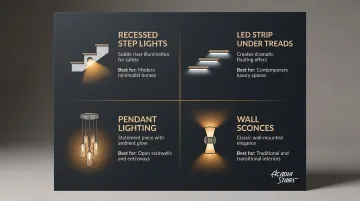
Integrated lighting is especially effective in spaces with high ceilings or open stairwells, where the staircase serves as a vertical focal point visible from multiple areas.
Color and Surface Treatments
A few low-cost changes can completely shift the feel of a staircase:
- Paint risers in an accent color while keeping treads natural for bold contrast
- Use wallpaper or a gallery wall to turn the staircase wall into a design feature
- Add picture molding or wainscoting for architectural detail along stringer walls
- Stain or paint treads in alternating colors or finishes to create a subtle pattern
Under-Stair Space Utilization
The under-stair space represents a valuable design opportunity. Houzz highlights this area as ideal for built-in storage, reading nooks, wine racks, or small home offices. Even a modest under-stair alcove — framed out with trim and fitted with shelving — can reclaim 20 to 40 square feet of usable space without touching the home's footprint.
How to Choose the Right Staircase Design for Your Space
Space and Floor Plan Considerations
The first filter for staircase selection is available space and floor plan. Straight and floating designs suit narrow or open-plan spaces; spirals suit tight footprints (requiring as little as a 4-5 foot diameter); L-shapes fit well into corners; grand curved or dual staircases require significant square footage and ceiling height. Work with measurements before falling in love with a style.
Spiral staircases can ascend several stories while occupying only a small circular footprint, making them ideal for loft access, basement connections, or secondary exits. Curved staircases typically require inner radius specifications of 24-36 inches and outer radius extending to 10 feet or more.
Design Language and Aesthetic Compatibility
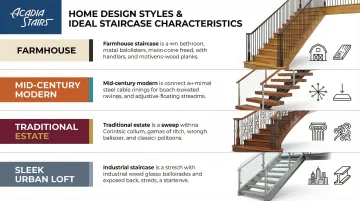
The staircase should reflect and complement the home's overall design language:
- Farmhouse-style homes — warm wood with black metal accents
- Mid-century modern homes — open-riser floating treads with minimal railings
- Traditional estates — sweeping curves with ornate iron balusters
- Sleek urban lofts — industrial metal and glass with exposed structural elements
Budget and Durability Considerations
Material cost and fabrication complexity vary widely. Custom staircases generally range from $5,000 to over $10,000, with floating styles often starting between $8,000-$12,000. Tread replacement alone costs $1,800-$2,500, while glass railings range from $1,500-$8,500.
Investing in quality materials and professional fabrication pays off in safety and long-term property value. Custom-built staircases avoid the compromises of off-the-shelf solutions.
Acadia Stairs' process covers collaborative design consultation, 3D rendering, precise shop drawings, and nationwide shipping — giving homeowners and designers across the continental United States and Hawaii access to modern and contemporary metal staircases built to exact specifications.
Building Code Compliance
Before finalizing any design, building codes set non-negotiable parameters. Consulting a staircase specialist early — particularly for structural changes or custom metalwork — prevents costly surprises later:
- Riser height: Maximum 7.75 inches (residential)
- Tread depth: Minimum 10 inches (residential)
- Uniformity: Greatest riser or tread within a flight cannot vary by more than 3/8 inch
- Headroom: Minimum 6 feet 8 inches (80 inches) measured vertically
The widely accepted step formula is 2R + T = 24-25 inches (where R is riser height and T is tread depth), aligning with natural walking rhythm for safety and comfort. Structural alterations typically require building permits and often require a structural engineer's sign-off, especially for load-bearing modifications.
Frequently Asked Questions
What is the formula used to design stairs?
The standard stair design formula is 2 Risers + 1 Tread = 24 to 25 inches (approximately 600–630 mm). This ensures a comfortable walking stride. Typical riser heights range between 7–7.75 inches with tread depths of 10–11 inches per building code guidelines.
What is the most popular staircase style for modern homes?
Floating open-riser staircases with metal stringers and wood treads are the most sought-after style in contemporary home design. Their open structure lets light pass through, making them a natural fit for open-concept floor plans.
What materials are best for staircase treads?
Hardwood (oak, walnut, ash) remains the most popular choice for its warmth and durability, while metal, concrete, and stone are favored in modern or commercial settings. The best material depends on the home's style, traffic level, and maintenance preferences.
How do I make my staircase a focal point?
Choose a distinctive staircase shape (floating, curved, or spiral), use contrasting or high-quality materials, add statement railings, and incorporate intentional lighting. Together, these choices transform a staircase from a functional necessity into the architectural centerpiece of a room.
What is the difference between a floating staircase and a traditional staircase?
A traditional staircase has closed risers (solid panels between treads) and a visible supporting structure underneath, while a floating staircase has open risers and treads that appear suspended — often cantilevered from a wall or supported by a hidden steel stringer — creating a lighter, more contemporary look.
How much does a custom staircase cost?
Custom staircase costs vary widely depending on materials, complexity, and size. Most projects range from $5,000 to well over $10,000 — a long-term investment that adds both function and measurable property value.