
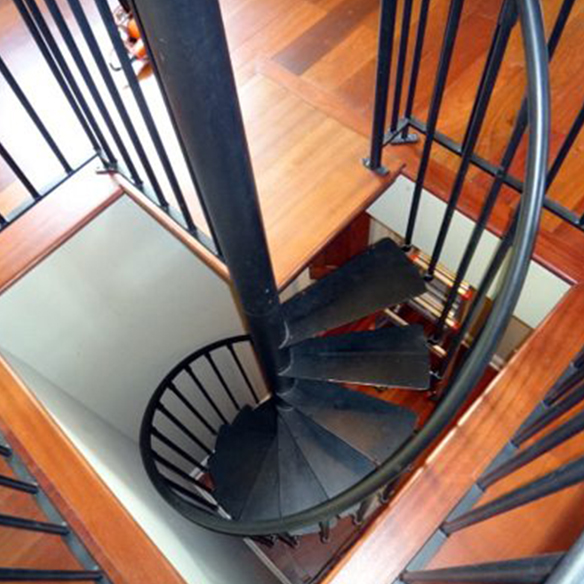
Spiral staircases have long been admired for their compact footprint and eye-catching design. They are often used in lofts, small homes, outdoor spaces, and modern interiors where both function and visual impact matter. While spiral stairs offer many advantages, they are not the right solution for every space. Understanding the benefits and potential limitations can help you decide if this style fits your project.
Here is a closer look at the pros and cons of spiral staircases.
The Advantages of Spiral Staircases
Space Saving Design
One of the biggest benefits of spiral staircases is how little floor space they require. Their circular layout allows them to rise vertically without the long runs and landings found in traditional stairs. This makes them ideal for small homes, lofts, basements, and areas where space is limited.
Because they take up such a small footprint, spiral stairs often allow more room for furniture, storage, or open floor plans.
Strong Visual Appeal
Spiral staircases are naturally striking and often become a focal point in a room. Their curved form adds movement and architectural interest, making them popular in both modern and traditional settings.
With a wide range of material options, including wood, metal, and glass, spiral stairs can be customized to match many interior and exterior styles.
Flexible Placement
Another advantage of spiral staircases is their versatility. They can be installed indoors or outdoors and in areas where a standard staircase would not fit. Spiral stairs are commonly used for decks, rooftop access, loft spaces, and secondary staircases.
Because they do not require a long straight run, they can be placed in corners, tight spaces, or areas with unique layouts.
The Drawbacks of Spiral Staircases
Narrower Tread Width
Spiral staircases typically have narrower treads than traditional stairs, especially toward the center column. This design is part of what makes them compact, but it can also make them less comfortable for some users.
People carrying large items may find spiral stairs more challenging to navigate compared to wider straight staircases.
Limited Accessibility
Because of their compact and curved design, spiral staircases may not be the best choice for everyone. They can be more difficult for young children, older adults, or individuals with mobility concerns.
For homes where accessibility is a top priority, a traditional staircase with wider treads and gentler angles may be a better solution.
Not Ideal for Primary Staircases in Every Home
While spiral staircases work beautifully as secondary stairs or in small spaces, they are not always the best option as the main staircase in a busy household. High-traffic areas may benefit from a wider, more traditional staircase that facilitates easier movement between floors.
Careful planning helps ensure the staircase meets the daily needs of everyone who uses it.
Is a Spiral Staircase Right for You?
Spiral staircases offer a unique combination of space efficiency and design impact. They are excellent for small areas, secondary access points, or spaces where a striking architectural feature is desired. However, they may not be the best choice in every situation, especially when accessibility or heavy daily use are a concern.
Explore Custom Spiral Stair Options
A spiral staircase can be both a functional solution and a standout design feature when it is thoughtfully planned. Acadia Stairs designs and builds custom spiral staircases for indoor and outdoor spaces using materials such as metal, wood, and glass. Our team works with homeowners, builders, and designers to create staircases that fit the layout, style, and needs of each project. Visit our contact page or call (845)765-8600 to learn more about custom spiral stair options and start planning a staircase that enhances your space.