Introduction
Floating stairs look deceptively simple: open risers, minimal visible support, a design that seems to hover between floors. That simplicity is exactly why pricing them is so hard. A conventional framed staircase has a fairly predictable material list — a floating staircase doesn't.
Many homeowners start their search expecting one clean number and end up with a spread of estimates that don't seem to describe the same project. That's no accident.
U.S. pricing swings based on:
- The structural system carrying the load
- How many flights or turns the design needs
- Tread and railing materials
- Local code engineering requirements
- Whether installation is included in the quote
This guide covers realistic pricing tiers, the line items behind a floating stair budget, how floating stairs stack up against traditional stairs, the costs people tend to forget, and a practical way to request quotes you can actually compare.
Key Takeaways
- Treat floating stair prices as a range; confirm if a quote is materials-only, delivered, or fully installed
- Straight runs with steel stringers cost least; complex geometry and premium materials raise prices fast
- Budget early for engineering, permits, shipping, and finishing—they often change the final number
- Higher spend usually buys stronger structure and smoother install coordination, not just looks
How Much Does a Floating Staircase Cost?
Floating stairs don't have a fixed sticker price, and part of the confusion comes from how differently providers define "cost." A quote can mean:
- Materials only – the stringer, treads, and hardware, no labor included
- Supply-and-delivery – fabricated components shipped to your site, uninstalled
- Fully installed – materials, delivery, and professional installation combined
Misreading which category you're comparing is where budgets fall apart. The three most common surprises:
- Underbudgeting the structural work
- Choosing a configuration your site can't support
- Discovering railings, engineering, shipping, or finishing were never in the quote
Three Realistic Pricing Tiers
Based on manufacturer pricing data, here is where U.S. floating stair projects typically fall:
| Tier | Typical Range | What's Usually Included |
|---|---|---|
| Entry-level/basic | $7,000–$15,000 | Standardized steel support, common tread material, basic or limited railing |
| Mid-range/standard custom | $15,000–$25,000 | Made-to-measure support, upgraded wood or metal treads, moderate railing scope |
| High-end/architectural | $30,000+ | Cantilever-style or concealed support, complex geometry, premium treads, extensive glass or custom railing |
These figures come from Muzata's 2024 floating stair pricing guide and reflect supply-side pricing, not full turnkey installation. Your final tier depends on geometry, tread material, and railing scope more than any single sticker price.
According to Fixr's 2025 staircase installation cost guide, fully installed floating staircases range from $15,000 to $100,000 depending on material, shape, and size. That wider spread shows how quickly finish and structural choices move the total.
Compared to traditional stairs, floating stairs carry a real premium. HomeGuide reports that a standard straight staircase installs for $1,900–$5,000, well below any floating stair benchmark. The gap comes from structural engineering, precision fabrication, custom components, and more specialized installation—not a flat percentage you can apply to every project.

Key Factors That Affect the Cost of a Floating Staircase
The final price reflects the entire stair system, not just how many treads you need. Structural decisions, material choices, and site conditions all pull the number in different directions.
Stair Configuration and Geometry
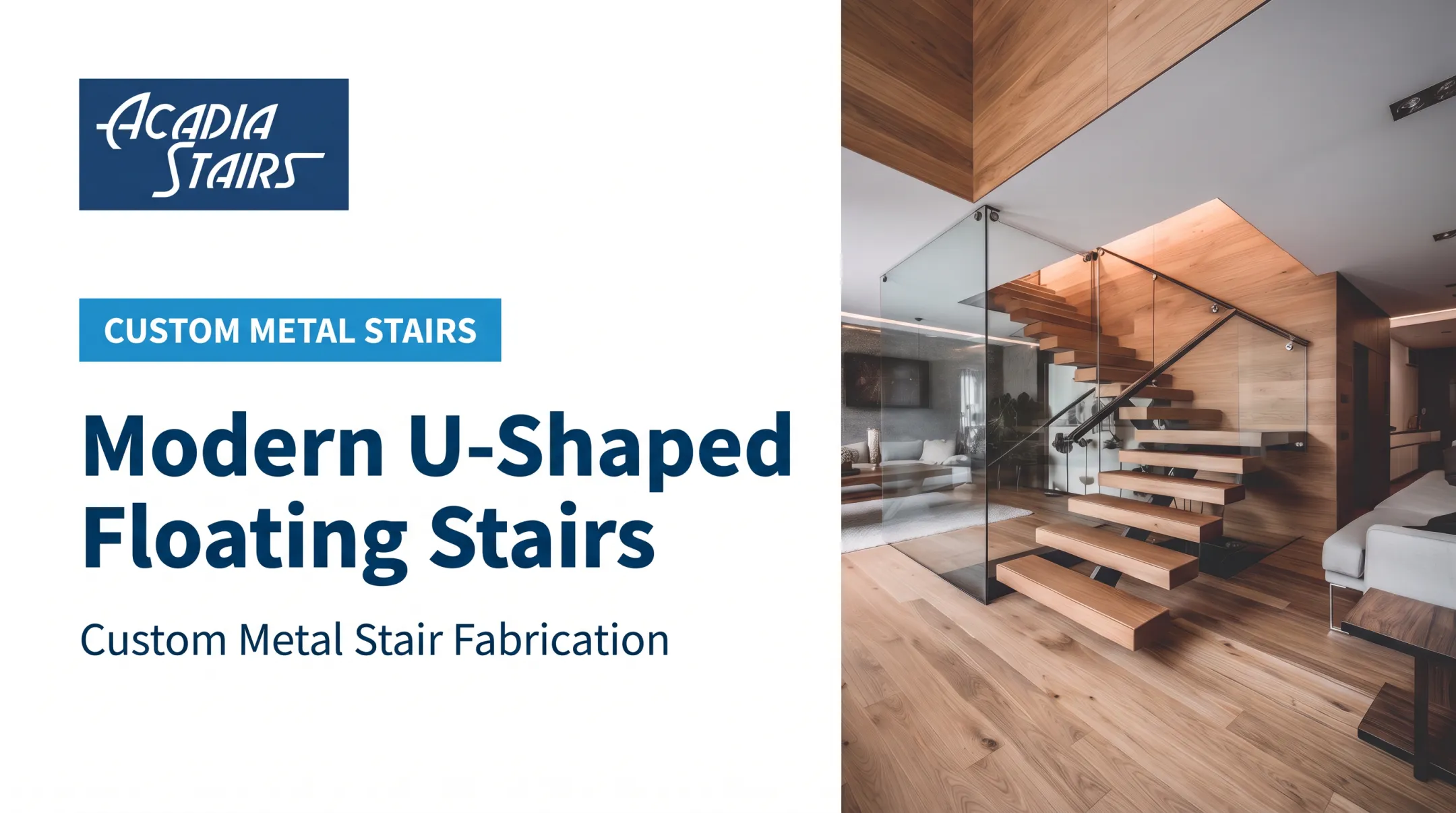
A straight flight is the simplest shape to fabricate, measure, and install. Add an L-shaped turn, a U-shaped switchback, a landing, a curve, or a second floor, and every part of the job — fabrication, support engineering, railing length, and install time — gets more complex. Curved and switchback designs consistently price above straight runs, though exact figures vary by shop and scope.
Stringer or Support System
The support hidden underneath is where floating stairs earn their name and their price tag.
- Mono stringer: one central beam with a simpler load path and moderate engineering
- Dual/double stringer: two supports that split the load and usually cost less than single-stringer designs
- Side-supported: stringers outside the tread edges for added strength
- Concealed or cantilever: support hidden in the wall or floor for a near-invisible structure
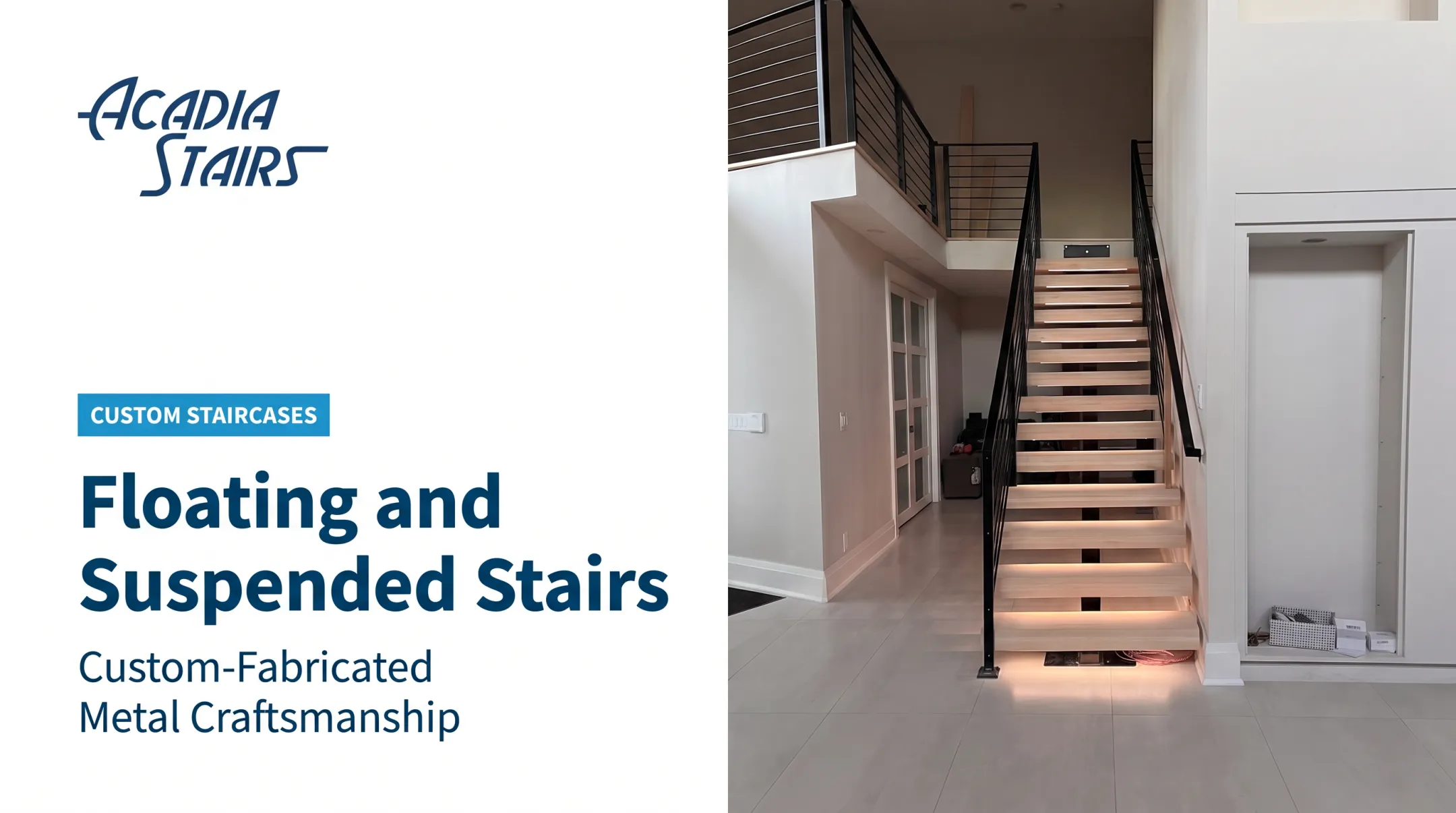
Acadia Stairs builds single-, double-, and side-stringer configurations, and typically prices double-stringer stairs more affordably than single-stringer designs, since the load splits across two supports instead of concentrating in one. A minimalist look often means more hidden steel and wall reinforcement, not less. Don't assume visual simplicity equals a lower bill.
Tread Materials, Dimensions, and Finish
Wood, metal, stone, and glass all behave differently once you factor in thickness, span, machining, and finish. Per-step material pricing (materials only, before fabrication and install) typically runs $50–$150 for wood, $80–$120 for stone, $100–$200 for metal, and $150–$250 for glass. Shop-applied finishes tend to cost less than site-applied work because they're done under controlled conditions before delivery.
Railing and Guard Systems
Railings are the most commonly underestimated line item. Cable, rod, picket, glass, and custom handrail systems price by linear foot, and that number multiplies fast once you add corners, returns, landing guards, and hardware.
Code plays a direct role here too. The 2021 IRC R312.1.3 opening limit prohibits guard openings large enough to pass a 4-inch sphere, which often forces tighter baluster, cable, or panel spacing than homeowners initially plan for.
Don't compare providers by a single label like "glass included." Measure the full railing scope (total linear feet, corners, returns, and guard height) before comparing quotes.
Engineering, Code, and Structural Readiness
Open risers, tread spacing, handrail height, guard height, headroom, and live loads all have to clear the locally adopted code, reviewed by a qualified design professional and the authority having jurisdiction. New construction lets you plan support, blocking, and floor openings early. Retrofits are a different story. Expect demolition, framing changes, reinforcement, and additional inspections that new-build projects skip entirely.
Installation, Access, and Customization
Floor-to-floor measurements, site access, lifting logistics, and finish-sensitive interiors all affect labor and change-order risk. Acadia Stairs ships nationwide and builds many of its stairs for straightforward on-site assembly, though installation itself is typically handled by the client's contractor or a capable homeowner rather than an in-house crew. Custom options such as powder coating add finish durability and color flexibility, and they can move the quote depending on color count and coverage.

Cost Breakdown and Budget vs. Premium Options
Breaking a floating staircase into line items helps you spot what's missing before you sign a proposal — and lets you compare bids on equal footing.
- Structural support and fabrication – Steel cutting, welding, concealed connections, and shop fit-up. Usually the largest single fabrication cost; get it itemized rather than bundled.
- Treads and finish – Material, thickness, machining, staining or sealing, and delivery protection.
- Railings, guards, and handrails – Posts, infill, hardware, landings, corners, returns, and code-required guards.
- Engineering, permits, delivery, and site prep – Structural review, shop drawings, permit/inspection fees, freight, floor-opening changes, and any demolition or reinforcement.
- Installation – Factory-built or modular stairs typically install faster than fully field-built ones, and site access affects labor either way.
Maintenance varies by material:
- Powder-coated metal: clean with mild detergent twice a year and after severe weather
- Wood treads: recoat every 5–10 years
- Cable and glass: periodic wiping, more often in coastal or high-traffic settings
Low-Cost vs. High-Cost Floating Stairs — What's the Difference?
| Factor | Budget System | Premium System |
|---|---|---|
| Structure | Standard steel stringer | Engineered concealed or cantilever support |
| Treads | Common wood species | Premium hardwood, stone, or glass |
| Railings | Simple wood or metal picket | Extensive glass, cable, or custom metalwork |
| Finish | Standard clear coat | Multi-coat finish, powder coating |
| Installation | Basic delivery | Coordinated site visits and install support |
A lower quote isn't automatically a better deal. If it excludes engineering, railing, delivery, or installation, you're weighing a partial scope against a full one. Compare the entire package, not just the headline number.
Acadia Stairs' custom metal staircases are built through a collaborative design process, shipped nationwide, and designed for straightforward assembly once they arrive on-site. Powder-coating options add finish durability and color choice. Whether that lands on the budget or premium end of the spectrum depends entirely on your configuration, materials, and site — which is exactly what a project-specific quote is meant to clarify.
How to Estimate the Right Budget for a Floating Staircase
Start with how the stair will actually be used: primary residential access, secondary stair, commercial circulation, remodel, new construction, or a statement architectural feature. That answer shapes everything else.
Before requesting quotes, record:
- Floor-to-floor height and number of treads
- Stair width and configuration (straight or turning)
- Landing requirements, if any
- Tread material and desired finish
- Railing length and indoor or outdoor exposure
Next, separate must-haves from upgrades:
- Structural configuration and code-required guards stay non-negotiable
- Premium wood, glass railing, integrated lighting, and custom geometry can be phased in or trimmed out
When quotes come back, ask every provider to itemize:
- Engineering and shop drawings
- Fabrication, treads, and railings
- Finishing, shipping, and installation
- Permits and payment milestones
Build in a contingency as well. General renovation guidance commonly suggests reserving 10%–20% of budget for unforeseen costs. Retrofit demolition or structural reinforcement is exactly the kind of surprise that eats into that cushion.

If you're a homeowner, architect, contractor, or designer weighing options, Acadia Stairs builds custom staircases shipped across the continental United States and Hawaii. Call (845) 765-8600 or email info@acadiastairs.com for a project-specific discussion.
What Most People Miss When It Comes to Floating Staircase Cost
Even careful buyers get tripped up by the same few blind spots:
- Fixating on stringer or tread price while overlooking railings, engineering, permits, shipping, installation, and floor-opening work
- Comparing a materials-only quote to a turnkey installed proposal and assuming the lower number wins. Those are not the same scope
- Choosing complex cantilever-style detailing or premium glass before confirming the structure and local code can actually support it
- Leaving responsibility unclear for field measurements, shop-drawing approval, delivery damage inspection, and site-condition changes
- Underestimating long-term maintenance: glass needs regular cleaning, wood needs periodic refinishing, and hardware on any system needs occasional checking
Shop drawings deserve extra attention here: once approved, most custom orders can't be changed or canceled, and the person who signs off is typically responsible for verifying the layout meets local code. That's not a detail to skim past.
Conclusion
Floating staircase cost comes down to several variables:
- Configuration and support system
- Materials and railings
- Engineering, site readiness, and installation
- The scope your specific quote actually covers
There's no universal number that captures all of that.
The right budget balances your visual goals with structural performance, code compliance, and long-term durability. Chasing the lowest headline price without checking scope is how projects run over budget mid-installation.
Before you request quotes, gather complete measurements and ask every provider to itemize their pricing. Compare full, equivalent scopes—not just bottom-line numbers—to keep your budget intact.
Frequently Asked Questions
How much does a floating staircase cost compared to a traditional staircase?
Floating stairs typically cost more. HomeGuide's data shows a standard installed straight staircase at $1,900–$5,000, versus $15,000–$100,000 installed for floating designs, according to Fixr. The gap reflects engineering, custom fabrication, and specialized installation.
How much weight can a floating staircase hold?
Capacity depends on the engineered support system, tread span, connections, and applicable building code. There's no universal number. Get project-specific structural calculations from your engineer or manufacturer before assuming a load rating.
What is included in the cost of a floating staircase?
Depending on the provider, costs may cover design, engineering, support structure, treads, railings, finishing, delivery, and installation. Get every item confirmed in writing, since scope varies significantly between quotes.
What is the cheapest type of floating staircase?
A straight-run design with a standard dual-stringer support, common wood treads, and a simple railing is usually the lowest-cost option. Local site conditions and code requirements still determine your final number.
Are floating staircases more expensive to install in an existing home?
Often, yes. Retrofits may require demolition, floor-opening changes, structural reinforcement, blocking, and finish repairs that new construction avoids. Budget separately for remodel work rather than assuming new-build pricing applies.
What factors increase floating staircase costs the most?
Complex geometry, cantilever or concealed support, premium treads, extensive glass or custom railing, and difficult site access tend to drive costs up the most. Exact impact varies by project, so confirm specifics with your fabricator.